The earliest record that I’ve found of my 3rd great grandmother, Charlotte Phillips, was an Oct 18,1851 ship manifest. She is listed as a 17-year-old female whose height was 5’ 1” and whose complexion was described as black. She was among 11 slaves, 3 women and 8 men for which Thomas Boudar was recorded as the owner or co-shipper. The manifest included the names of 153 slaves being shipped out of Richmond, Virginia to New Orleans aboard the Barque Virginian under the command of Capt. Nathaniel Boush. Barque, barc or barc were sailing vessels with 3 or more masts, of which all but the one at the stern is rigged with square sails.
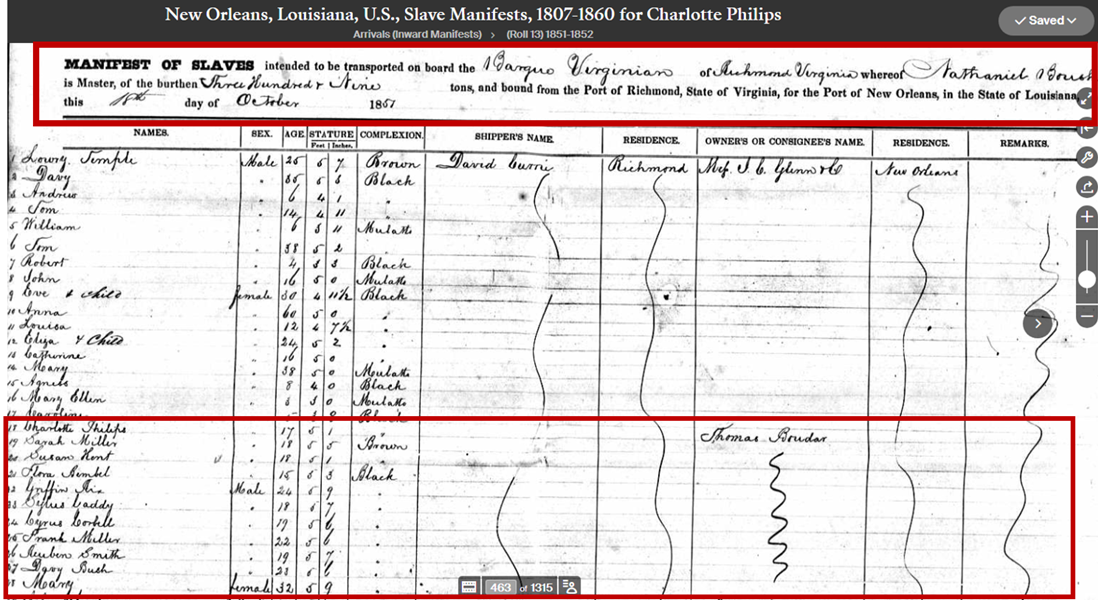 The heading on the manifest read: Manifest of slaves intended to be transported…out of burthen Three hundred and nine, and bound from the Port of Richmond, State of Virginia, for the port of New Orleans. I first found the manifest on Ancestry.com. In 2023, I learned of a database hosted by Rice University accessible at slavevoyages.org. I found Charlotte Phillips’ name listed on a manifest. Per the slave voyages database, Charlotte did not ship out of Richmond on Oct 18, but instead on Oct 22. Additional information was that the ship arrived in New Orleans on Nov. 11, 1851. This meant that Charlotte was aboard the Barque Virginian for 19 days. Where had she been between Oct 18 and 22?
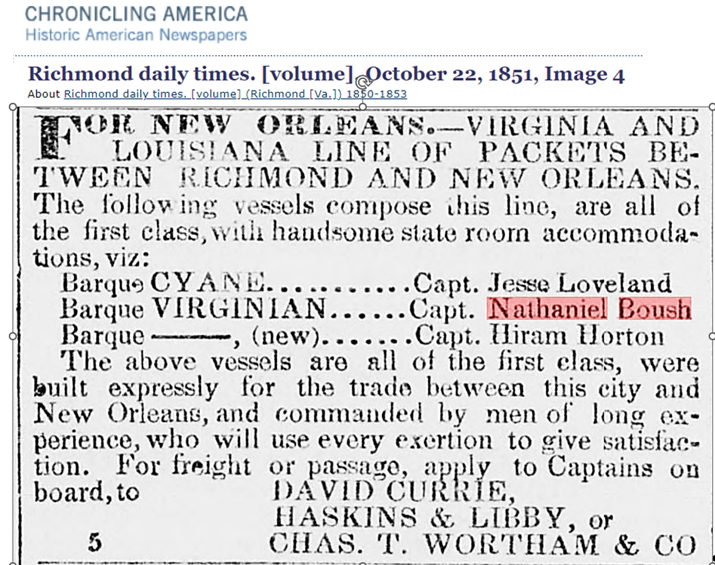
Research on Thomas Boudar revealed that he and Bacon Tait were partners. Bacon Tait owned perhaps as many as 2 slave jails in the Shockoe Bottom district of Richmond, VA near 15th and Cary Street from about 1834-1851. Other operators of slave jails were Silas Omohundro, George Apperson and Robert Lumpkin whose area on Wall Street, now 14th Street was referenced as ‘the devil’s half acre’. The jails housed 30-40 slaves who were waiting to be auctioned and also functioned as boarding houses for out-of-state traders and plantation owners. Lumpkins jails were also known as breeding houses. I have not found any information that indicates if Charlotte was held in one the slave jails while in Richmond or if she was held aboard the Virginian the 3 days before it sailed. I found in the Chronicling America news database an ad that ran in the Richmond Daily Times, that may explain the 3-day delay in Charlotte’s departure from Richmond. See the ad below.
Richmond Daily Times, October 22, 1851
Richmond Daily Times, October 22, 1851 obtained from Chronicling America
For New Orleans. Virginia and Louisiana line of packets between Richmond and New Orleans.
The following vessels compose this line, are all of the first class, with handsome state room accommodations, viz:
Barque Cyane Capt. Jesse Loveland
Barque Virginian Capt. Nathaniel Bousch
Barque —, new Capt. Hiram Horton
The above vessels are all of the first class, were built expressly for the trade between this city and New Orleans, and commanded by men of long experience, who will use every exertion to give satisfaction. For freight or passage, apply to Captains on board, to
David Currie, Haskins & Libby, or Chas. T. Wortham & Co
 All 153 slaves reportedly made the voyage to New Orleans. Among them were 2 slaves of interest: Susan Kent and Davy Bush. Interest in Susan Kent because her last name suggests she may have been a relative of Charlotte’s and Davy Bush because I was able to locate him alive in Louisiana on the 1870 and 1880 census.
Charlotte and family most likely lived in what was then St. Mary Parish. Iberia Parish was not created until 1870 from land taken from St. Martin and St. Mary Parishes. Union soldiers had arrived by 1863 to this part of Louisiana. A number of plantation owners fled to Texas with their family and their slaves. The Patout, Weeks, Brashier and Wilson-Huff families were among those who fled and hired out slave in Texas towns of Marshall, Brenham, Huntsville, Navasota, and in Texas counties: Falls, Fort Bend, Harris, Freestone, Smith and Walker. Several Civil War skirmishes were fought in St. Mary Parish. Cannon balls landed in sugar cane and cotton fields where slaves were working. Numbers of slaves followed the Union soldiers all the way to Morgan City and New Orleans and were called contraband. Some freedmen enlisted and served in the US Colored Infantry. A number were killed in 1863 on the Teche Bridge in New Iberia by Confederate soldiers while Union troops looked on. A large measle epidemic broke out in 1864 and there was a devasting flood or overflow as it was called in 1867 that wiped out crops for large numbers of families. The Freedmen’s Bureau provided provisions of pork, corn meal and molasses to those who suffered devastating losses, both Black and White. Were Charlotte and family impacted by these events? I have not found their names among those who applied for assistance. I do not know with certainty whose plantation Charlotte and Young lived or where they lived prior to 1870. I have not found marriage or death records for their older children; Maria, Eliza, Ida and Lincoln so I can not say where they were born. Luvenia death certificate indicates that she was born in St. Landry Parish, but I have not been able to verify that.
The next record of Charlotte is the 1870 Iberia Parish census. She is listed with 36 year-old Joe Smith and children Maria 16, Eliza 12, Ida 10, Lincoln 5, Lavinia 2, Addison 1 and Ella 4 months. Charlotte’s age is recorded as 35 and her birthplace as Maryland. Neither she or Joe could read or write. Their older school-aged children could read but not write. Joe’s occupation is listed as farm laborer and he had $100 in personal property which could be livestock, wagons or farm equipment. Charlotte’s occupation was recorded as ‘keeping house’.
Charlotte is next recorded on the 1872 purchase of 7 ½ arpents of land in Iberia Parish with ‘Young’ Smith from Lassolin Bonin and wife Cecilia Broussard. Her name is recorded as Charlotte Patout. My niece Latrice and I have puzzled over why her last name was as written Patout and have theorized that Charlotte and/or Joseph aka ‘Young’ were slaves on the Simeon Patout and Appoline Fournier family plantations. The Patouts had plantations in St Mary (now Iberia), Iberville and Assumption Parish. The Henry Wagner family was listed in the household next to Charlotte and Henry was a known slave of Simeon Patout. The Patout family was in fact located 4 pages away from Charlotte and family in 1870. The land purchased by Charlotte and Young was located on the west side of Grand Marais in a place called Isle Piquant (which means prickly or sharp, now known as Patoutville) and was bordered by property owned by Stephen Jenkins, Appoline Patout, Lassolin Bonin and John Baptist Davis (Adelaide Bonin).
Charlotte’s oldest child Maria was born in 1854 which meshes with Charlotte arriving in Louisiana in 1851. 1 year old Addison was Charlotte’s grandson and not her son–his mother was Mariah Smith. The next info on Charlotte is the July 15, 1878 marriage record of Charlotte Prichart and Young Smith. Why was her last name recorded as Pritchard and not Phillips or Patout? The witnesses were listed as Amos Rolison, Barney Thompson and Sidney Rollison, the minister as Rev T. Gates. I looked for a long time for Amos and Sidney Rolison and Barney Thompson before I discovered a Sidney and Emos Robertson living in Patoutville on the 1880 census. Perhaps the parish clerk PH Segura wrote the last names as he heard them spoken and as he thought they were spelled and may that explains the last name recorded for Charlotte.
I could not find Charlotte, Joseph or any of their children on the 1880 census. I know that Lincoln Smith and Lizzie Porter Jacobs had 2 children Charlotte Smith Jacobs Paul Lovette in 1885 and David Lincoln Smith in 1892 through the info on death and probate records. By 1880 the family would have been living in their newly acquired home which by all descriptions was in the middle of the Patout family sugar cane fields. Maybe the census takers did not count the family because they did not walk far enough down the road.
Charlotte was last recorded on the 1900 Iberia Parish census with husband Joseph Smith, and daughters Amelia 19 and Cora 15 and married son Oliver Smith 21. Included in their household were Eliza’s son Matthew Smith Schaffer, Amelia’s son Clarence Smith and Cora’s daughter Agnes. Charlotte had a daughter named Charlotte who with husband Thornton Tibbs were listed a few households away on the same census page. Charlotte was 70 years old, had given birth to 15 children of which 9 were still living. Using information from death certificates, census records, and the 1969 sale of the family farm, I have only been able to account for 12 children. According to census information, she and Joseph had been married for 35 years. Per census data, Joseph owned his farm, mortgage free. Amelia, Cora, Oliver and Matthew were farm laborers working either on the family farm or some other farm.
Charlotte’s daughters, Luvenia and Sarah were living in New Orleans at the time of the 1900 Census. Charlotte’s daughter Ella was married and was living with her husband Thomas Johnson in Patoutville. Luvenia and Ella would both later move to Lake Charles, LA with their families and were listed living in Lake Charles for the 1910, 1920 1930 and 1940 census. Sarah Smith, husband William Davis Sr and son lived in St Mary and Iberia Parish from 1910 until Sarah’s death in 1939. Amelia and Oliver Jenkins had at least 9 children together and lived in Iberia Parish. I don’t know if they lived on the 7-acre homestead of Charlotte and Joseph.
I have not been able to find out who lived in the house between 1910 and 1930 as I have not been able to find Amelia and Oliver for census years 1910 and 1920. Charlotte died March 12, 1913 in Lake Charles, LA and was buried in Tab Nicole Cemetery (most likely Tabernacle Cemetery on Pear and Griffin Street off Prater Road). Her death certificate listed her parents as Joseph Phillips and Charity. The informant was her son-in-law, husband of Luvenia Smith, James A Perkins. Parent names are often omitted or left blank on death certificates for formerly enslaved people. The names of Charlotte’s parents were vital in connecting her to her Calvert County, MD family.
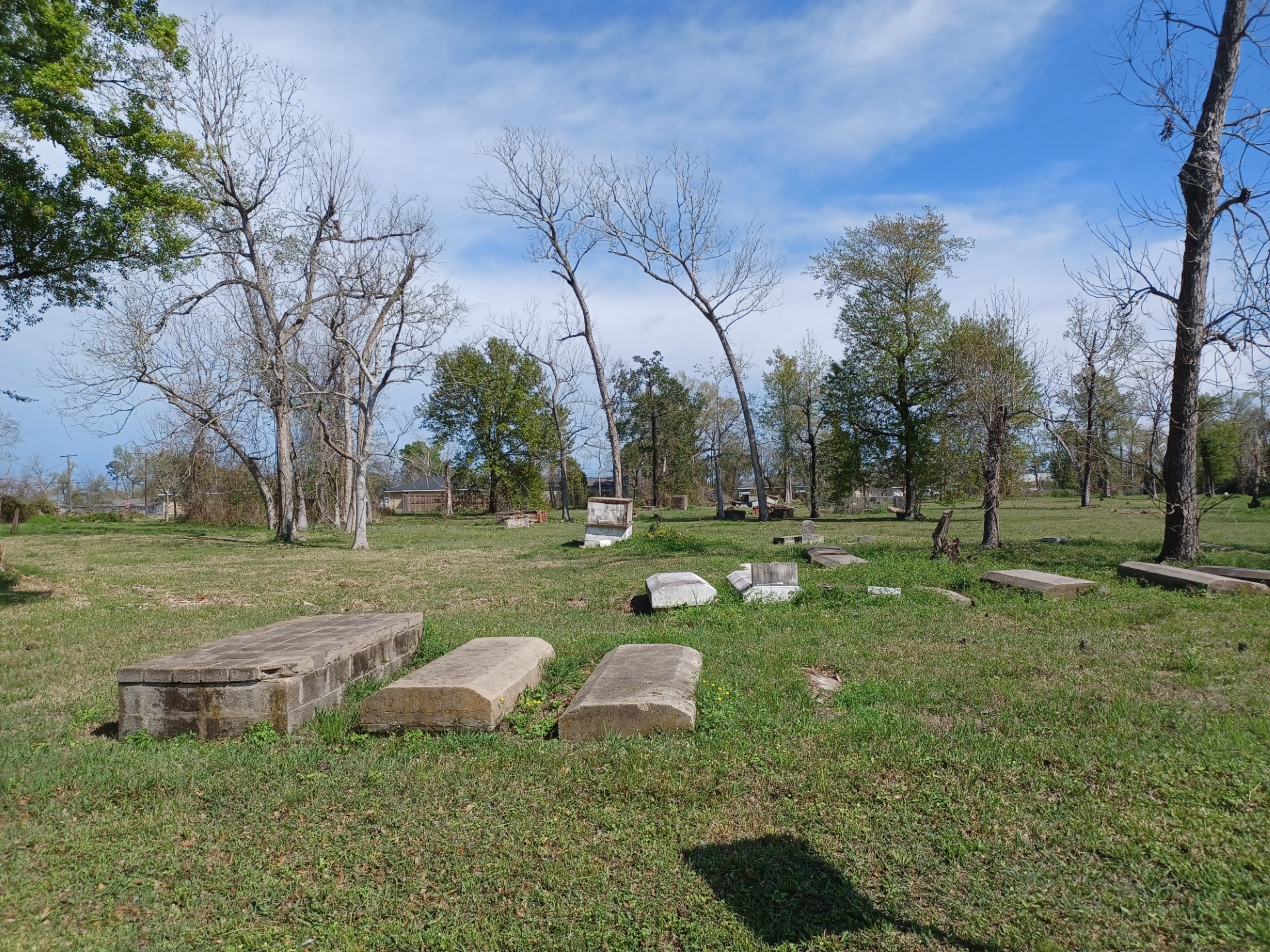 I wonder what stories Charlotte may have told her family about her life in Maryland. I imagine that she must have spoken about the family that she left behind, at least about her father and her daughter Charity, because those names were recorded on her death certificate. I would later figure out that Joseph Phillips was her father and Charity was her daughter. The informant had the information partially correct, but provided just enough to help us connect Charlotte to her long left-behind Calvert County, Maryland family.
Once I knew that Charlotte last name had been Phillips, I started looking closely at my mother’s DNA matches in Ancestry.com. Three profiles were key to making that connection—the profile of Cora G who was my mother half 2nd cousin, 1x removed or 3rd cousin. The others were Destinysmom12 and beulah. Destinysmom12 was also a half 2nd cousins 1x removed or 3rd cousin. Beulah was a 3rd cousin 1x removed. As an additional bonus, I discovered Cora’s DNA in Gedmatch.com. Cora and my mother matched each other 106cM on 8 DNA segments. Two of those segments were on chromosome 23 suggesting that the common ancestor was female. I looked at Cora’s partial tree in Ancestry and found Hester Watts on the 1910 census, with husband Virgin Watts and children whose last name was Jefferson. Looking back to 1900 I found a widowed Hester Jefferson. When I looked back to 1870, I found Hester counted twice-once as Hester Fawney with parents Eliza and Major Fawney and siblings. On that same page was 74-year-old Hester Phillips and in her household was 36 year old Joseph Phillips, 22 year old Charity Phillips, 1 year old George Phillips and 14 year-old Joseph Tawney. So, there was Charlotte’s family, all on one page in 1870.
Young Hester was recorded a second time on the 1870 census was as Hester Tawney, age 4 with her parents Eliza and Major and siblings. In the household preceding theirs was Rhody and William Peter Kent. 2 households away was 18-year-old Robert Jefferson, whom she would later marry. I found a 36-year-old man named Peter Phillips living in close proximity to Joseph Phillips Jr and Eliza Torney. Peter was Charlotte’s older brother. His death certificate as well as that of Eliza and Joseph Phillips Jr all listed their father as Joseph Phillips.
I have not been able to find any information about Joseph Phillips Sr or about Hester Phillips born about 1796. The Calvert County courthouse records were destroyed in a number of fires including one in 1882. So, there are no marriage, probate, death or deed records to document Charlotte or her family.
While I can’t say with 100% certainty, I believe that Charlotte and family were slaves on James Laveille Sr’s farm. James Laveille died 1857 and shortly afterwards his daughter Rebecca married Basil Sewell Dixon in Baltimore. Basil freed 4 slaves in 1863 so that they could serve in the Union army during the Civil War. He attested that he became possessed of Peter Kent, Thomas Torney, Samuel Key by marriage in September 1858. Thomas Torney died of typhoid fever in 1864 before leaving Maryland. His widow Anna Maria Green applied for his pension and described knowing Peter Kent at the time of her marriage to Thomas. She further testified that Peter Kent and Thomas Torney were cousins.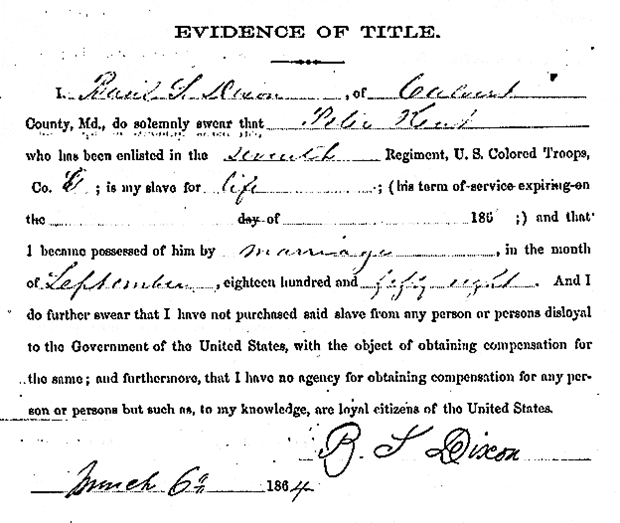
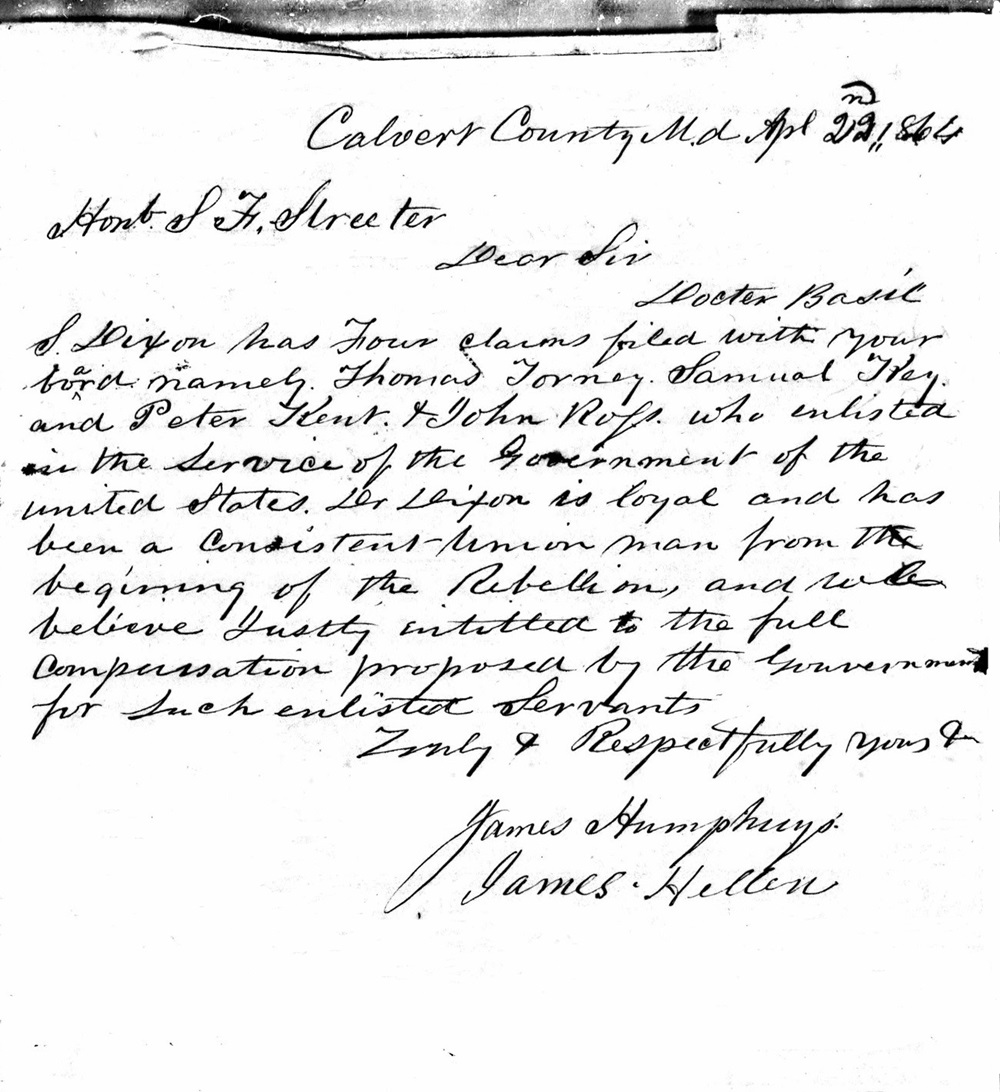 And while I don’t have any probate or deed records to prove that Charlotte’s family were enslaved by James Laveille Sr., the fact that Charlotte’s sister Eliza Phillips married Major Torney and that Basil Dixon is listed on the 1870 and 1880 US Census in very close proximity to Eliza and Major Torney as well as Joseph Phillips Jr. suggests that Dixon may have inherited Charlotte’s family by way of marriage to Rebecca Laveille after Charlotte was sold away. Basil Dixon owned 6 slaves in 1840, 14 in 1850 and 49 in 1860. None of his slaves were old enough to be Charlotte’s parents. By contrast, James Laveille owned 16 slaves in 1820, 19 slaves in 1840 and 30 in 1850. Some of these slaves were in the right age-range to have been Charlotte’s parents. The Laveille family had been in Maryland since the 1700s.
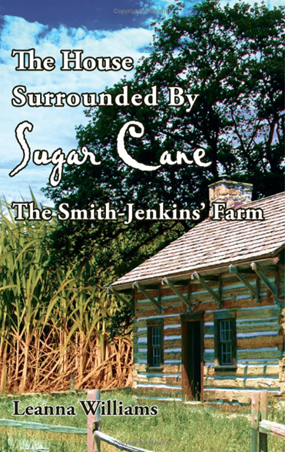
Charlotte’s great granddaughter Leanna Williams wrote, “The House Surrounded by Sugar Cane” in 2000 as a part of her church, New Canaan Missionary Baptist Church’s celebration of Texas/Louisiana Day celebration. The book was published in 2006. Leanna described the property so vividly that I could almost see it—a front yard filled with what she named ‘happy foods’; tomatoes, cucumbers, watermelon, cantaloupe and corn. Happy foods because they could be eaten with asking permission. She wrote that the property and was filled with the aroma from orange, plum and cedar trees. The house was unpainted and had a tin roof, wooden shutters and a fireplace that served the kitchen/living room and the bedroom. The house had back porch and Louisiana styled front porch with 2 entrances to the front of the home. From Leanna’s writing it clear that the trees were most likely planted before her father Livingston Jenkins moved into it in the mid 1930s. I like to think that Charlotte and Joseph aka Young or their children under the direction of Charlotte or Joseph, planted those trees with plans for feeding and nurturing themselves, their children and children’s children.
See a rendering of Charlotte and Joseph’s house as created by Latrice N. at
Video: The House Surrounded by Sugar Cane
https://www.youtube.com/watch?v=RZYGdVZejPQ
Best,
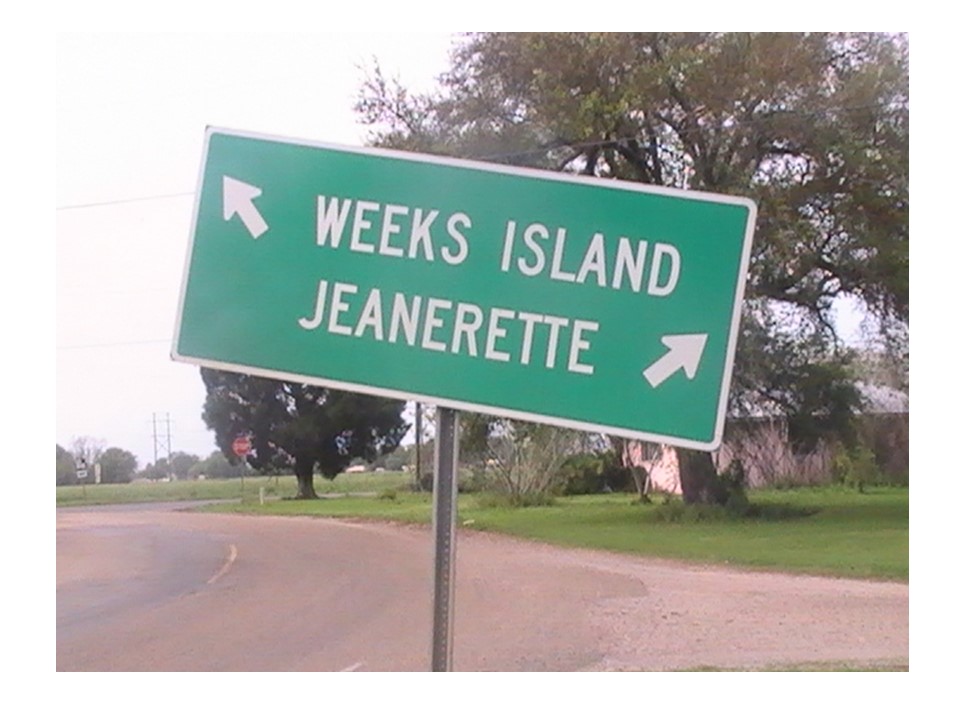 I am looking for anyone who has Robert Jenkins and/or Bridget Guy Jenkins in their family tree. I am a twig that sprang from the Jenkins Tree. My ancestor is Oliver Jenkins, son of Henry Jenkins of St. Mary and/or Iberia Parish, Louisiana. Henry’s parents are listed as Robert and Bridget. The problem is that I can find Bridget on federal census pages 1880 – 1910 in Patoutville and Jeanerette, but I can only find Oliver from 1900 onward and can only find Henry beginning in 1900 after he married his second or third wife Mary Mathieu. I have never found Robert on any census listing, Louisiana or Texas. And, Bridget is not listed until 1880.
 My Maryland-Louisiana Roots