Sarah Weeks the Mother of Robert ‘Bob’ Gibson’s Children?

In 2021 I stumbled on the Palfrey Papers that were housed in the Fondren Library at Rice University in Houston, TX. Among the many documents I found were William T Palfrey’s 1842-1859 Plantation Diary as well as letters between John Palfrey and sons William, Henry and John Gorham. I found information on my paternal 3rd great grandfathers Robert ‘Bob’ Gibson and James ‘Jim’ Morgan. Both were young children listed among the slaves sold by Relf & Chew to John Palfrey March 9, 1811. Bob was listed with his mother Aime and siblings: Joe, Tom, Ben and Fannie. James was not listed in any family group. Also listed were Sam and wife Mima and daughters Sally and Anna.

I was able to easily determine that James Morgan’s wife was Sally Riggs and that their children were George, Ambrose, Mima, Mahaley, Phoebe and Hortense ‘Fortune’ Morgan. Fortune’s death certificate listed her mother as Sally who was born in North Carolina. Additionally, Sally, Jim and children were listed on John Palfrey’s 1843 probate.

Bob or Robert Gibson was not included in John Palfrey’s 1843 probate as he and James ‘Jim’ had been swapped by John and William Palfrey in 1835. So, there was no document laying out Bob’s family. I found death certificates for Fanny Marshall and Elsie Morgan that listed their father as Robert Gibson. Neither death certificate provided a name for their mother. My family descended through Elsie Gibson, and I found many DNA matches from Elsie’s descendants and also from Fanny Gibson & William Marshall. So, I now knew Robert had at least 2 children: Fanny and Elsie.

When I read William T Palfrey’s diary I saw references to Nancy, daughter of Bob and also of Caroline, wife of Bob giving birth to Letty in 1854 and Lewis in 1864. hen knew that Bob had another daughter Nancy. I’d already found Bob with Caroline, Letty and Lewis on the 1870 census. I found additional information in the plantation diary of another daughter of Bob’s–Charity. Palfrey wrote of Bob transporting a Charity and her daughter Sidney from Franklin to Cypremort in the midst of the Civil War taking place all around them. In 2026, I found a DNA descendant of Charity in Ancestry to further substantiate that Charity was Bob’s daughter. But I still had no name for the mother of Fanny, Elsie and now Charity. Charity’s daughter Ellen Green Betts was interviewed by the WPA in the Texas Slave Narratives. She told of her life in St Mary Parish and mentioned several names https://www.ancestry.com/imageviewer/collections/1944/images/BYU325-01462?pId=6819.

On a visit in 2024 to the St Mary Parish courthouse, I found an April 27, 1838 deed, Folio 178, Entry 4400. Included was a list of slaves: Bob 35, Peter 34, Anderson 36 as well as Sarah 35 and children: Dave 12, Aimy 16, Nancy 9, Kizzy 30 and Eliza 7 and Cyrus 4.

When I got back home, I went through all of the Palfrey journals and letters again and found a 5 page account book for 1832 for William Palfrey. On one page were the names of young Palfrey slaves:

  • Aimy born Oct. 3, 1821,
  • Charity born 8/2/1824,
  • David born 9/16/1826,
  • Nancy born Oct 10, 1827
  • Elisa born Nov 23, 1830
  • Anthony born Sep 6, 1831
  • Cyrus born May 11, 1833
  • Fanny no birth date listed

On the following page was a list of slaves on his plantation in 1832. That list included John, Jim, Peter, Anderson, Sarah, Roy, Amy, Charity, David, Nancy, Kizzy & her child Elisa, Sinah, Manuel, Jesse, Harriet & her child Anthony.

The names in the 1832 account book almost totally mirrored the names in the 1838 deed record. Names of interest that were missing from the 1838 deed record were the names Charity, Fanny and Sinah. And missing from the 1832 account book records was Bob. Bob was still among the slaves of William’s father John Palfrey. William and John Palfrey formally swapped the men in 1835. Sarah’s name precedes the names of Aimy, Charity, Dave and Nancy in both the 1832 account book and the 1838 deed record. Sinah’s name is listed in the 1932 account book, but the order of the names in the list suggests that she is not the mother of Bob’s children who are listed above her.

So, who was this Sarah?

I scoured William Palfrey’s 1842-1859 diary again, this time looking for references to Sarah. I found 2. Palfrey wrote that Sarah Weeks ran away for a few days and returned May 12, 1848 of her own accord. He wrote that Sarah died Dec 11, 1851 at the age of 55.

Palfrey referred to Sarah as Sarah ^ Weeks. Had she been a slave of Palfrey’s earlier partner Davids Weeks? How did she come to live on William Palfrey’s plantation? Were her mother, father or siblings also on Palfrey’s plantation or a Weeks family member plantation? Was she the mother of all of Bob’s children Aimy through Elsie?

Was she David Gibson’s mother? My mother, my sisters and several close cousins are relatively close DNA cousins to many of David Gibson’s descendants. All of David Gibson’s descendants are DNA cousins on my mother’s maternal side while all of her matches through Charity, Nancy, Fanny and Elsie are on her paternal side. How can this be?

I need to do more research to make this make sense. Until then…

Best,

Finding Joseph A.K.A Young Smith’s Father

If you’ve followed my blog for a while, you may have noticed that most of my most detailed findings have been on my mother’s paternal side and include her Gibson, Morgan and Riggs ancestors. I have been able to trace them as far back as 1811 because of letters, journals and probate and other written materials by and about John Palfrey and family of Boston, Mass. and later St Martin and St Mary Parishes in Louisiana.

Similarly, much information was uncovered on 1/2 of my mother’s maternal family which includes the surnames: Guy and Jenkins and my paternal ancestors: Fournice and Shoals ancestors. These names were included in probate records of the Weeks, Meade and Weightman families.

The other 1/2 of my mother’s maternal tree were uncovered through 2 female DNA matches in Ancestry.com and Gedmatch.com: CG and Destinysmom12. These 2 DNA profiles and the family trees that were pieced together cemented our Calvert County, Maryland heritage. I ‘d been able to find my 3rd great grandmother, Charlotte Phillips’s family alive on the 1870, 1880 census still living in the vicinity of Solomons Island, Calvert County, MD.

After my success finding Charlotte through DNA profiles and matching members on family trees, I focused next on finding the family of Charlotte’s husband, Joseph ‘Young’ Smith, my 3rd great grandfather. Joseph had been born about 1835 Kentucky and as per the 1900 census data, so were his mother and father. Back in 2015 in Ancestry.com there were 2 profiles of relatively high matches (67cM and 40cM on 2 segments) whose family trees included people who lived in Kentucky. These 2-profile people were related to one another. Their family trees included the surnames: Sutton, Ray, Merimee, Gardiner, Roth, Elder, Hamilton, Higgins Howard, and Mayfield. These 2 profiles were my mother 3rd cousin or half 2nd cousin 1x removed. The two matched a third profile who was a 105cM match on 4 segments. This third profile was for a man who stated that he was adopted and so had no family tree.

So, my niece Latrice and I determined that we could maybe connect Joseph ‘Young’ Smith to these 2 Kentucky DNA-profile families by figuring out the family tree of this third profile. If we could then connect him to the other 2 profiles, we would then know how we all were connected.

I found a DNA profile for that third person also in Gedmatch.com. In Gedmatch, I was able to see his highest shared matches with my mother and his highest matches that did not match her. He had several very high matches with people whose family trees included people who lived in Overton, County, Tennessee. We next compared his high matches with each other and were able to triangulate on 1 surname, Harges sp Hargis.

So, we tracked men and women from this family to see who moved west and lived in Iowa, Nebraska, California and Arizona. We found obits, marriage records, and newspaper articles that helped in our search. Sometime in mid-2019 Latrice and I had connected the Overton County, TN branch of profile #3 to the 2 Kentucky profiles. The names that all three profiles had in common were Gardiner and Merimee.

The Gardiner family was from Charles County, Marland and this branch had moved to Nelson County, Kentucky by late 1700s or early 1800s. The Gardiner family lineage has been very well documented going back to the late 1600s and is quite extensive. Many Gardiner descendants have moved to St Landry Parish, Louisiana and lived somewhat near my Smith-Phillips family in Iberia Parish.

The Merimee family was harder to trace. The patriarch of the family was William Merimee who was reported to have been born about 1750 in France. By 1798 he was in the United States and living in Fayette County, Pennsylvania. He was reported to have married Mary Magdalene LeBrun a native of France. He moved with his family to Nelson County, Kentucky sometime after 1800.

Which of the 2 surnames Gardiner or Merimee had a connection to Joseph ‘Young’ Smith?

As the years passed between 2015 and 2019, more and more DNA profiles appeared in Ancestry.com that all included the Gardiner-Merimee surnames. As we compared each of the new profiles, we were perplexed because each of the new Gardiner-Merimee profiles seemed to match only one another, my mother and her immediate family.

We could not figure out how none of the 15 or more profiles failed to match any of the known Gardiner families in Louisiana or a Gardiner family living anywhere!!! There were so many Gardiner descendant DNA profiles that we found among the Public Member family tree section in Ancestry.com. Not one of them matched my mother. Similarly, we found several of family trees that included the surname Merimee. William Merimee had at least 2 sons; Frederick and Thomas and 1 daughter Prudence. All the DNA profiles in Ancestry had Thomas Merimee at the top of their family tree and his wife Maria Eliza Gardiner.

At the time my niece and I kept saying that either Maria Eliza is Joseph Smith’s mother or Thomas Merimee is his father. But we did add either to our family tree. We moved on to researching the connection of other members of our family.

Months and then a year or 2 years passed.

2025 was a new year and I narrowed down my list of “have to knows” from the myriads of things to just 2 things. One of those things was, “who were Joseph ‘Young’ Smith’s parents.

So, I set out to figure out who Joseph’s parents were. There were two things that had always been great curiosities about Joseph: the name with which he was documented and that he was listed as a Mulatto male on the 1870 census, but not the 1900 census. On the 1870 and 1900 census records for Iberia Parish, he was listed as Joe and then Joseph. But he was referred to ‘Young’ Smith on the 1872 purchase of land with Charlotte and on his 1878 marriage record to her. Both the deed and marriage record were legal records of a sort and he was referenced as Young and not Joseph. Why? Had his father been Joseph Smith Sr? Had Joseph originally been on a plantation or farm owned by a Smith and he was just one of the young boys living there? Had he been on a plantation owned by the Young family?

My niece built a Gardiner-Merimee tree in Ancestry. She researched the original William Merimee and discovered that he had a brother and/or a son who went by the name Lewis Marymee. A Lewis Merimee had lived in Pennsylvania in 1800 and a Lewis Marymee had married in Bullitt County, KY in 1822 and later died 1834 or 1835 in Sullivan County, IND.

I started adding to the tree the Latrice had started, focusing on Lewis Marymee’s descendants. I traced each of his 5 sons and added their families to the tree. Newspaper articles, marriage and death records helped trace the families through the decades. I traced one branch of his family to Houston, Texas by 1900 and added those names to the family tree.

Finally, I added a surname to the tree that flashed in my memory. I’d recently seen that name as a new addition to the now more than 70 DNA profiles that matched the Gardiner-Merimee group that I’d created in Ancestry. Some had family trees, some had useable profile names, other had gooblety-goop for profile names. This new DNA profile name used the surname that I’ d just added as a new name to our research tree. This profile also matched 7 profiles of the known descendants of Thomas Merimee and Mary Eliza Gardiner. This profile shared only 12cM on 1 segment with my mother. Per Ancestry, she is my mother 4th cousin or half 3rd cousin, 1x removed.

This new profile was a descendant of Lewis Marymee, who was the brother, son or grandson of William Merimee. In any case, we now knew that Joseph Smith’s connection to this large Gardiner-Merimee group was through a Merimee and not a Gardiner.

And so I called Latrice and said again what we’d both said years before, “Thomas Merimee has to be Joseph Smith’s father!”

I then wanted to know all about Thomas Merimee. All that I had known was that he was born about 1802 in Nelson County, KY, that father died about 1805 and that his mother died about 1841.

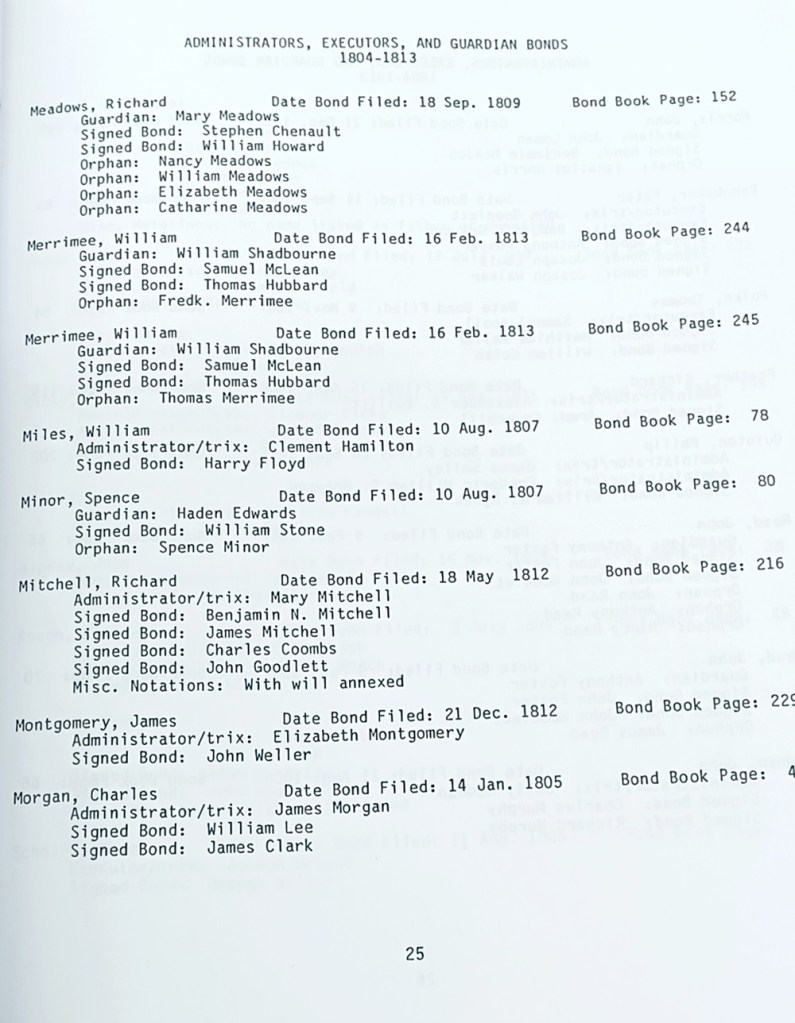
Thomas and Frederick Merimee orphans, guardian William Shadburn

Additional research uncovered a Bond Book in which Thomas and his brother Frederick were listed as orphans. In 1813, William Shadburn, the young husband of their older sister Prudence was appointed to be their guardian. I could not find much information on Thomas’ mother Mary Magdalene Lebrun. What I did find was: an 1810 Nelson County, KY census record for a household of 4 and a 1812 marriage record of her daughter Prudence to William Shadburn; and a record of Mary Magdalene ‘Prudence’ birth of 1765 and death in 1841 on a tombstone in the St. Joseph Cemetery in Bardstown, KY. The tombstone inscription included the words ‘Wife of William Merimee’.

I found Thomas Merimee living in Jefferson County, KY at the time of the 1830 census. His household included him, his wife and 2 male children under the age of 5, 1 male child over 5 and 1 female slave between the age of 10 and 23. Joseph ‘AKA’ Young Smith was born about 1835. By 1840 Thomas was again living in Nelson County, KY. His family now totaled 8 and include 1 female slave between the age of 10 and 23. If the female slave listed in 1830 and 1840 were the same person and for her to have been between 10 and 23 for both census terms suggests that the was 12 years old in 1830 and 22 years old in 1840. If she was Joseph’s mother, then she would have been 17 years old when he was born in 1835.

Thomas was listed on the 1850 and later census as a blacksmith. He most likely owned a blacksmith shop either on or near his home. The only additional information that I have found regarding Thomas is the marriage and death records of his daughters and sons and their descendants.

I am curious to know who was the 10-23 year-old female slave counted in Thomas’ household in 1830 and 1840 and what became of her. Was she Joseph Smith’s mother, his sister, an aunt or related to him at all?? I’ve been looking at probate records for Maria Eliza Gardiner’s family members to see if Thomas Merimee may have acquired this young female by way a dowry.

So, Latrice and I have figured out who was Joseph ‘Young’ Smith’s father–Thomas Merimee 1802-1878. Now to find his mother and perhaps the reason he was called “Young Smith”.

Best,

Walking in Their Footsteps

Ask anyone who knows me, and they will say that I am a genealogy enthusiast at best or that I am a genealogy nut at worst.  My son once said that I could find a way to swerve any conversation into the genealogy lane.  A significant part of my obsession with genealogy research includes the who begat who stuff.   I want to trace my lineage as far back as possible. I want to know, if possible, where we got or chose the surnames on the family tree: Guy, Jenkins, Smith, Gibson, Riggs, Morgan, Hill, Alexander.  I want to know how my Maryland, Virginia and Carolina ancestors came to be in Louisiana.   I understand how the lure of wealth in the industries of sugar cane, cotton, rice, etc. led to the movement of slaves to the south and west.   I’ve read many slave narratives that detailed how people were trafficked by way of steamships equipped with sails through New Orleans from Richmond, VA, Charleston, SC, or Savannah, GA or shipped down rivers on flatboats and paddleboats or conveyed overland in coffles traveling through Alexandria, Winchester and Abingdon, VA, through Atlanta, GA, Montgomery, and Mobile, Ala to Louisiana. After reading these stories, I wanted to know my ancestors’ stories–who brought them, how they travelled, who they left behind, or if there is DNA evidence to link me to those left behind.   I want to know how they lived, what they did for work and pleasure and anything that might help inform me on how we, I, came to be the people, person that now live.   In essence, I wanted to walk in their footsteps.

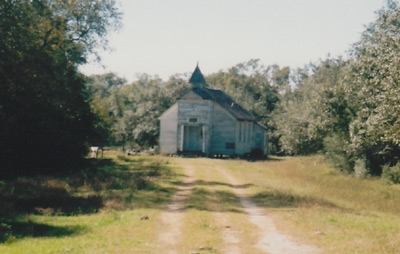
St Mary Baptist Church, El Maton, Texas

During my initial years of genealogy research, I sometimes felt that I was being led or otherwise drawn to pursue certain research paths or to focus on certain people.  My initial research focused on my husband’s family because they had been slaves in Texas counties within driving distance to where we lived.  The lives and stories of three women on his family, Iris Temple and her daughter Easter Temple Rivers Hadden as well as Iris’ great granddaughter Cassie Martinez continually beckoned me to keep digging out their stories.  I drove to El Maton and Wilson’s Creek in Matagorda County.  I’d read that Wilson’s Creek had been used to move goods to and from Palacious Bay.  When I saw it 2001, it was a mere gully.  Along its banks was the Moore/Deadrick Family Cemetery.  The St. Mary Baptist Church that the family once attended had been relocated to a nearby lot.  I walked the land where Iris once lived and along Wilson’s Creek where Easter was recounted to love to fish in the evenings.  Cassie was born there and attended school there through the age of sixteen.  The surrounding area was quiet and peaceful, filled with the sounds of birds chirping and squawking and of cows mooing.  The Temple, Moore and Rivers men had been mostly cattlemen and not primarily farmers.  The family has a photo of a young Cassie sitting on a coral fence.  I could feel a connection to the place and to the people who once lived and walked that land.

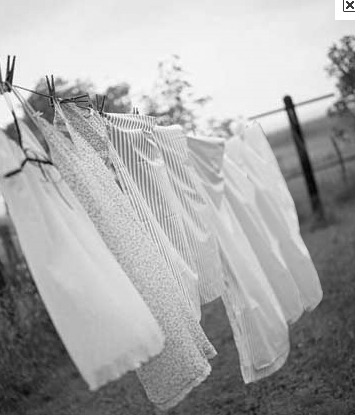
As I research my Louisiana ancestors, I’ve been attempting to walk where they’ve walked.  The homes that both my grandparents built still stand.  I have memories of using washboards and wringer washing machines and of hanging out the wash on clotheslines.  I can almost see my grandmother Josephine standing at the kitchen door looking out and smiling her little crooked smile.  I can smell the honeysuckle that grew in the lot between their home and the Pentecostal church on the corner.  When I close my eyes, I can see yellow day lilies and liriope grass with its purple flower stalks that lined my paternal grandparent’s front walkway or the crepe myrtle and Rose of Sharon trees beside the carport.  I can see the laugh-lines that creased my maternal grandfather’s face and hear faintly my grandmother Sarah saying, ‘Oh, Preston!’  When I think of those houses, smells and sounds come to mind.  I can almost smell Pine-o-Pine and cedar, Sub Rosa deodorant, Tide washing powder, frying fish or chicken and Stein syrup.  The smell of chopped onions, bell peppers and garlic come to mind as do the smells of fig, pear, corn and watermelon rind preserves being cooked.  I can almost hear the radio announcer call baseball games with my grandfather talking in the background about how he played as a young man.  Sometimes I can hear my grandfather Preston calling out Elijah’s name in his sleep.  I can almost hear the whine of my grandmother Sarah’s sewing machine and see her holding the fabric close to her face because of her poor eyesight.

I have memories of my grandparents, but realize I know almost nothing about them.  I realized that I don’t know who planted the flowers or trees or under whose direction they were planted or cared for.  Both grandfathers built their own homes—how did they know how to do that, who taught them?  Sarah was an excellent seamstress and Josephine a phenomenal cook—who taught them?  I have walked where my grandparents walked and still have quite clear memories of them.  I am still walking in their footsteps and holding on to words and beliefs that they spoke.  My grandparents often said the words, “God willing…”

So, I will continue my journey to see what I can find about in whose footsteps my grandparents walked and plan to take a walk myself either intellectually or physically in those footsteps.  I know that something I discover will entice or beckon me to keep digging out their stories.

Best,

Creating Lazarus Kits in Gedmatch

I created an account in Gedmatch.com early in my DNA genealogy research. In 2015 a 4th cousin match to my mother’s Ancestry DNA messaged me and asked that I create an account in Gedmatch. He did not detail the advantages of using Gedmatch but he periodically continued to ask. I could see that he and my mother shared 25cM of DNA. I didn’t know what a cM was or if a 25cM match was worth investigating. I finally did create an account and discovered that their match was on chromosome 11. I compared his DNA with my mother’s and saw the people who matched 1 or both kits. I was able to see his family tree, which was also in Ancestry.com. A unique tool in Gedmatch allowed me to see that some of the people that he and/or my mom matched, were not always matches to he and my mom. I then looked at some of these non-matches for my mother and found that some did match some of my mother’s other DNA cousins. Interesting right! That is the randomness of DNA inheritance.

In 2015 Ancestry had something called DNA circles to which everyone’s DNA was assigned. I never really got how the circle thing worked and pretty soon the circles were replaced with Parent 1, Parent 2 and Both Parents subgroups. I found this tool helpful. I’d figured out how a key DNA profile was connected to my mother’s DNA. She was in the Parent 1 subgroup and her 2nd great grandmother and my mother’s 3rd great grandmother were sisters. That person’s DNA was also in Gedmatch and my mother matched her on 8 chromosomes, 10 segments including 2 segments on the 23rd. So, the whole group thing worked for me. That is until I looked recently and saw that this person’s profile in Ancestry is now in the Unassigned group. What happened!!

Throughout my research using DNA tools, I have found that what begins as a trek through shared matches with profiles along my Parent 1 branches often mysteriously goes off track and lead to matches on my Parent 2 branches. So, how did this profile that I thought was concretely attached on my mother maternal Phillips line become Unassigned. Why was this key profile not placed in the ‘Both Parents’ subgroup?

I decided to try out the Gedmatch Lazarus Kit tool to try and replicate my mother’s parents DNA profiles. I used my mother, siblings and close family on my mom’s maternal and paternal side that were in Gedmatch. To create a robust Lazarus kit for each of her parents, I had to do 2-person kit comparisons to find enough DNA profile matches to meet the 1500cM threshold required by Gedmatch. When I compared my key Phillips’ matches DNA to my mother’s DNA in an attempt to fill out her mother’s Lazarus kit and other cousins’ DNA to fill out her father’s Lazarus kit, I saw significant people show up as matches for her maternal and paternal Lazarus kits. It finally sunk in. My key Phillips match was indeed a match somewhere back in time to both my mother’s father and her mother.

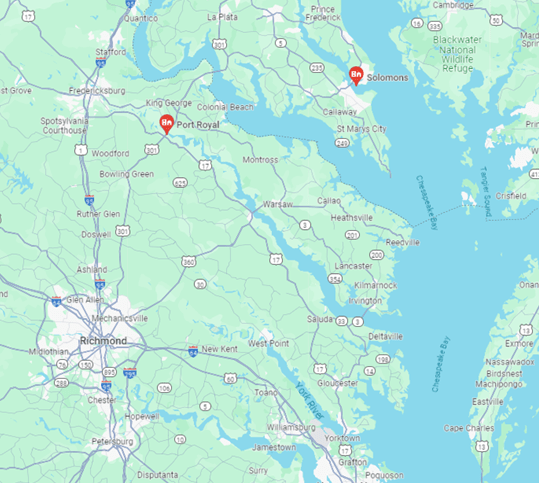
I’ve traced my mother’s Parent 1, maternal line branch back to Calvert County, Maryland through Charlotte Phillips. Charlotte’s husband was Joseph ‘Young’ Smith who was born in Kentucky. This 1 part of her Parent 1 bucket. Her oldest known ancestors along her Parent 2 branches were supposedly all born in Virginia and North Carolina. One of her ancestors on the Parent 2 line has a number of matches whose ancestors lived in Caroline County, Virginia. When I looked at a map, I found the distance between Calvert County, Maryland and Caroline County, Virginia to be about 55 miles.

55 miles!!

Map, Port Royal, Virginia to Solomons Island, Maryland

What do you do, when what you thought you had nailed down in your research, turns out to be just another pivot down another rabbit hole?

Well, I am attempting to get more close cousins on both sides of my mother’s tree to upload their DNA to Gedmatch in hopes that I can nail something else down. Hopefully, these Lazarus kits will help sort things out!

Best,

Design a site like this with WordPress.com
Get started