Genealogy research can be described in many ways. The research journey can be described by words like: circular, confusing, exciting, exhausting, exilic, fun, frustrating, rewarding, tedious, tiring and totally worth it. My approach to genealogy research varies–sometimes I am analytical, creating theories of familial relationships and then following threads and clues to substantiate or invalidate the theory. At times my approach is instinctual. I have continued to look for family members who have seemingly disappeared because I sense that they are somewhere waiting for me to find them. Most of my successful genealogy finds have come by pure accident. I liken it to being on an Easter egg hunt and not finding any eggs or candy, but instead finding a chest full of precious gems or treasure. Treasure that isn’t hidden or buried, but simply laying out in the open, waiting to be found.
That is how I stumbled upon my Guy and Jenkins family. I theorized that my great great-grandfather Philip Jack was a slave on the Weeks family plantation because he purchased land Feb 9, 1881 from Stephen Gay. Gay purchased the estate of Alfred Weeks in 1867. Now, I thought I was on the trail of finding information on my paternal side about my grandfather Milton’s great-grandfather, Phillip. Information about the Weeks family was readily available from various online resources. I’d heard of Weeks Island because my grandfather often fished there.
In 2021, I found an article written in 2019 by Phebe Hayes in the Journal of the Iberia African American Historical Society about the 1835 David Weeks ‘Inventory of Enslaved Persons”. I found a listing of slaves in the inventory of David Weeks on page 7. The eighth slave named was Bridget, 12, daughter of Jenny. I shouted at my computer screen, “Hold on! What! That’s my Bridget!!!” The fifth slave was Jenny, 34, wife of George. Other children recorded with Jenny as their mother were Isaac, 17; and Nancy, 15. Included with Jenny on line 5 were: Amanda, George, Abram and Martin. Martin was Jenny’s one-year-old son.
Martin was a name that I’d remembered–there were 2 men that I knew of named Martin connected via marriage to my paternal family. Martin Joseph and family lived on Henkle Street, the next street over from my grandfather. Martin Joseph had married my paternal great aunt, Carrie Antoine. The other Martin was someone that I’d heard my grandfather mention–his name was Martin Guy. He talked about Martin always sitting on his front porch. Martin Guy was no longer living, but at one time lived down the way from my grandfather on Pellerin Street. I had previously found Bridget recorded on the 1900 US census twice in Iberia Parish, once with the last name Jenkins and once with the last name Guy. Once again, I shouted at my computer screen, “Guy? ”
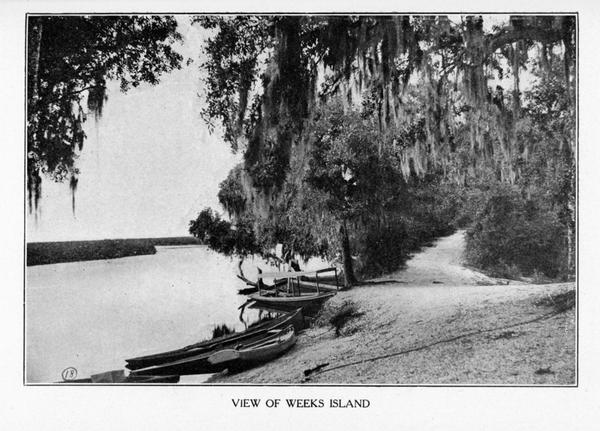
So, sensing that I had found the Rosetta Stone to both my Jenkins and Phillip Jack family, I anxiously scrolled down the article for the name Phillip. I found the name on page 10 among a small group of slaves who lived at the New Iberia property, ‘The Shadows’ in 1835. I was so excited to find listed with Philippe, his parents and siblings: Amos, 35; Patty, 30; Henry, Caleb and Susan. No ages were provided for any of the children. My ancestor Phillip was listed on US Iberia Parish census records 1870 through 1900. His age varied on each year, but he was born sometime between 1821 and 1839. He could have been the Philippe listed in the 1835 inventory! But I undoubtedly had stumbled on my Jenkins family!! And, now I thought I’d found a link between the Guys and Jenkins.
Among the sources for the article was a mention of David Weeks’ 1846 inventory. I was now obsessed to find that 1846 inventory.
I knew Phebe. She and I had communicated electronically since 2015 when we discovered that we were near kin. Near kin in that two of Bridget’s daughters married Robertson men. Phebe descended from one of the Jenkins/Robertson branches. I descended from Bridget’s son Henry, making Phebe and I near kin, not DNA kin. I’d finally met Phebe in 2018 at the Iberia Parish Courthouse!
I eventually obtained a copy of David Weeks’ 1846 inventory from Rice University’s Special Collections. I simply went to the library, showed my ID and got access to a computer for 2 hours. I quickly located the 1846 probate and inventory and saved it to a USB drive. I found information on Bridget, her parents George, 66; and Jinny as well as her siblings: Amanda, 22; Abram, 18; Martin, 12; Lewis, 15; and Nancy, 26. In the years between 1835 and 1846, Bridget had 3 children: Nancy, 7; Emily, 4; and Isaac, 1. Her sister Amanda had 3 daughters; Silvia, 5; Mary Ann, 3; and Sina, 5 months. Bridget’s 26-year-old sister Nancy was listed with 2 children; Kitty, 6; and Henry, 4.
The family was divided and partitioned to various children of David Weeks and his widow. Bridget’s brother George was described at little George and was in the partition of slaves provided to David Week’s widow Mary Conrad Weeks Moore (Judge John Moore). Bridget and children were in the partition given to Alfred Weeks. Her sister Nancy and children were in the partition given to Harriet Weeks Meade Weightman. Also in Harriet Weeks allotment were George, Abram, Lewis and Martin. Bridget’s mother, Jinny, was included in Harriet’s partition. Jinny was recorded without an age and her value was listed as ‘maintenance’.
Page 6 of the 1846 inventory listed slaves that had died since the earlier 1835 probate. Included among those who had died were Patty, Henry and Philip. Also, among those slaves who had died, was Isaac, 17-year-old son of Jenny.
So, I’d found a Philip. A Philip who was in the right place, in the correct age range to be my Phillip Jack, but not my Phillip. This is typical of the ebb and flow of genealogy research–highlighting the exciting, frustrating and rewarding aspects.
And so, I continue to dig into my treasure trove of Weeks family documents to uncover more about my Guy/Jenkins roots. Simmering on the back burner of my mind is Phillip Jack. I hope to purposefully find Phillip’s story, but I am totally open to accidentally stumbling onto his story!!
Read about Abram Guy and his family.
Up Next:
Bridget Guy’s Story and
Henry Jenkins’ Story, how many wives did he have?
Jenny & George Guy
George Guy
George Guy was born about 1780. I am not sure if he was born in Maryland or Virginia. His daughters Bridget Jenkins and Amanda Williamson are the only children that I can say with certainty that I found after the end of slavery. Bridget father’s birthplace was listed as Maryland on the 1880 US census but was recorded as Virginia for the 1900 census.
I first found George’s name on the 1835 David Weeks’ probate inventory of slaves. He was listed on the 4th line and described as a Mulatto driver about fifty-five years old and valued at $700. On successive lines were listings for his wife and children. Once I knew where George had lived as a slave, I looked to document how and when he may have come to be on the Weeks plantation and to know more about his life.
I read about the Weeks family and discovered that David’s father William Weeks had lived in W. Feliciana Parish Louisiana. In courthouse records for that parish, I was able to see that William sold a group of slaves to David on Oct. 2, 1817. Many of the slaves named in that 1817 sale were also on the 1835 probate, including the name George. The information recorded with George was a valuation of $1100. Another male, ‘John the blacksmith’, also was valued at $1100. Valuations for other male slaves were somewhat or significantly lower. Perhaps this was my George! And though no descriptor was provided, he may have been valued the same as the blacksmith because he was a driver.
I next found George on the finalized 1846 probate for David Weeks. George was among the slaves allotted to Harriet Weeks. He age was sixty-six and he was valued at $5.
Jenny Guy or Gill or Gael
Jenny was born about 1801 in Maryland or Virginia. I think I found her listed in the US census records for Iberia Parish in 1870 and 1880.
Jenny was listed with husband George and children on the 1835 David Weeks’ inventory. She was thirty-four years old–much younger than fifty-five-year old George. Included on line 5 with her were children: Amanda 9, George 7, Abraham 5, Lewis 4, and Martin 1. On lines 6-8 were Isaac 17, Nancy 15, and Bridget 12.
Jenny was next mentioned in the 1846 David Weeks probate. She was among the slaves in the partition provided to Harriet Week. She was recorded as ‘Jinny‘ and her valuation was for ‘maintenance’. No age was provided for Jenny.
I found a 1870 US census record for a seventy-eight-year-old Mulatto female named Jenny Gill. She lived in Iberia Parish, Ward 1 and was listed on page 167B. She was a mid-wife whose birthplace was recorded as Maryland. In the household with her was Colla Roman, 40; and Lydia Roman, 14. I have not yet discovered if there was a connection between those in the household.
Jenny was still living in Iberia Parish at the time of the 1880 census. She was included in enumeration district 72 on Page 410B. She was an eighty-year-old widow from Maryland. Her name was recorded as Jenny Gael. Both parents were recorded as haven been born in Maryland. In the household was: Charles Handy 35, his wife Rosa and his mother Emily Baker, 58 as well as his cousin Hampton Arnold and nephew Robert Flood. Jenny was listed as Charles’ grandmother.
Jenny’s daughter, Bridget and Bridget’s daughters Caroline and Dora were listed on the 1880 Iberia Parish census. But they lived in Ward 1, enumeration district 26. Bridget and her children: Nancy, Emily, Stephen, Lewis, Caroline and Dora all lived in close proximity to one another with the exception of Henry Jenkins who lived in St Mary Parish. Bridget’s sister Amanda Guy Williamson also lived in enumeration district 26 with her daughters: Sinah Joseph (Phillip) and Mary Ann Rose (Isaac). My instincts tell me that this Jenny Gill or Jenny Gael, is my Jenny Guy. But it seems a little unlikely that if Bridget and Amanda were her only surviving children that they would not also have lived near Jenny.
I have not been able to figure out where Emily Baker was on the 1870 census and if Jenny was actually her mother. I’ve obtained Charles Handy’s death certificate and it presented more question than it answered. I am also researching the Hampton Arnold and Robert Flood connections. Connecting those dots may help me figure out if this Jenny was indeed Bridget’s mother.
Census workers wrote her name as Gill and Gael. Some of my other Guy relatives names were written as ‘Guile’ or ‘Gye’. Perhaps the enumerator’s primary language was French or Spanish and they heard Guy but wrote it as it would have been written in their native language.
So, I have more items on my genealogy to-do list. Was this Bridget’s mother? If so, when and how did she come to Louisiana? Was she one of the Jenny on William Weeks’ 1817 list? Was her last name Guy or was that George’s last name?
Best,
 My Maryland-Louisiana Roots