Martin Guy

Martin Guy was a man on my family tree for whom I have found many descendants, but a man who I have not been able to find on any census record. Martin was the son of George and Jenny Guy. Most of what I know Martin Guy is through marriage records of his son Ezekiel George Guy and by way of Ezekiel’s civil suits for recovery of property owned by his deceased siblings, Abram and Maria Guy.

The beginning of what I know about Martin’s story is that his father George was a slave on the plantation of William Weeks sometime before 1817. On Oct. 2, 1817 William Weeks sold George and at least 48 other slaves to his son David Weeks. The sale was recorded in West Feliciana Parish, Louisiana, Parish Book A, Folio 491-492. In a separate recording of that same sale (Afro-Louisiana History and Geneaology), George was listed as George Elivin. This was a transcription error–George was valued at eleven hundred dollars. Two females named Jenny were sold in 1819 by someone by the last name of Weeks, most likely William Weeks who died Oct. 22, 1819 in St Francisville, LA. The sale is recorded in Estate Number: 26-A-088-033-1819.

George was recorded as a fifty-five-year-old Mulatto driver on David Weeks’ 1835 probate. Jenny, age thirty-four, is listed as his wife. Listed with Jenny are children Amanda, 9; George, 7; Abraham, 5; Lewis, 4; and Martin 1. Listed on successive lines beneath Jenny are Isaac, 17; Nancy, 15; and Bridget, 12.

Martin, 12 next appears in the 1846 final partition of David Weeks’ estate. He along with brothers, Lewis and ‘Little Abram’ as well as parents George and Jinny (Jenny) were among the slaves in the allotment given to Harriet Weeks Meade.

Charles C Weeks and his siblings took large numbers of slaves to Texas in 1862 or 1863. They each took slaves to different counties in Texas and hired them out to work; in fields, for the railroad and to haul products as far away as Brownsville and Mexico. Martin was mentioned in Charles Weeks’ April 28, 1864 letter. Weeks wrote that he had secured a contract to haul bacon to Shreveport when one night, Martin, Milton and Ben left him near Homer in Angelina County, Texas. Apparently, they ran away. Martin, Milton and Ben must have been drivers, because Weeks next wrote that he “hired two white drivers & drove the third wagon myself.” Weeks also wrote that he’d learned that “one of his Negroes were in jail” but that he did not know where. He did not seem to know which of the 3 men was jailed. I have looked for Martin in Texas and Louisiana in 1870 and onward but have not yet found him.

I have found his children: Abram, Ezekiel, Maria and Milry Guy on the 1870 Iberia Parish census. Abram Guy, 15 was listed in the household with his grandparents Sommerset and Peggy Furnice. Sommerset and Peggy had several daughters: Eliza, Minerva, Minty, Amy and Leah. I have not been able to determine which of these was Abram’s mother.

Abram Guy married Mary Johnson or Asbury. They lived in Rosetown and were included in the 1880 Iberia Parish census with children: Patsy, 6; Henry Handy, 4; and Martin, 1 month. Abram and wife were recorded on the 1900 census. Census data noted that they had been married for twenty-seven years. Included in the home were children: Virginia, 17; Hester, 12; and Martin, 18. Also in their home was granddaughter Stella, 5. Neither Abram or Mary could read or write but all of their children were able to do so. Abram worked as a ditcher and owned his home.

Abram had mostly likely died by 1910 as his son Martin Guy and wife Gertrude were listed on the 1910 census living in the residence where Abram previously had owned between Polite Joseph and Raymond Antoine. Included in Martin’s home in 1920 were children: Bertha, Louisa and Robert.

Ezekiel George Guy, 11 was recorded in the home of his aunt Amanda Guy and her husband Jacob Williamson for the 1870 census. Ezekiel’s 1895 New Orleans marriage license listed his parents as Martin Guy and Patsy Ly?? He married Mintie Young, daughter of Henry and Celeste Young. He and wife Mintie were included in the 1900 US census in New Orleans with daughters, Celeste, Mary and Katy. Ezekiel worked as a day laborer and lived at 414 Burgundy Street. He and Mintie were able to read and write.

Ezekiel married Estella Haywood in 1907. His name on the license was recorded as George Guy and his age as forty-one. His parents’ names were recorded as Martin and Patsy Guy. Ezekiel and Stella and appeared on the 1910 LaFourche Parish census with their son George. Ezekiel was listed as George Guy and worked as a bricklayer. He and Stella were still in LaFourche Parish at the time of the 1920 census. Included in their home were George, 11; Octavia, 9; Samuel, 7; Armour, 4; Clarence, 2; and Hazel, 1.

By 1930, Ezekiel was back in Iberia Parish. He was recorded as a seventy-year-old married man. Estella and children were counted on the 1930 Orleans Parish census. Estella was listed as a widow.

Estella and family moved to Pasadena, California and were listed on the 1940 census. She worked as a cook and lived 544 W. Pepper Street. Ezekiel and wife Katie Rose were listed on the 1940 Iberia Parish census.

Ezekiel filed in civil court to obtain the property rights of his deceased siblings Abram and Maria Guy. In one of his filings, he included the name of former wife Estella Haywood. Ezekiel died June 19, 1944 in a Lafayette hospital. Ezekiel’s granddaughter Octavia Estelle Butler was a highly regarded science fiction writer of works such as Kindred, Bloodchild and Fledgling. She also received the MacArthur Foundation “genius” grant.

Maria Guy was born about 1858 to Martin Guy and Charity. She was listed on the 1870 Iberia Parish census in the household of Emus and Charity Spahe along with Anna and Josephine Gatewood. I know that Maria Guy purchased land from Mrs. Emma Henkle April 1900, Book 38, Folio 138, but I have been unable to find Maria on any census after 1870.

Best,
Mimy and Sally, Women on My Family Tree

Mimy

Mima or Mimy was the mother of Sally Riggs, my fourth great grandmother; the grandmother of Ambrose Morgan, my third great grandfather; the great grandmother of Martha Morgan, my second great grandmother; and my mother’s great great-grandmother.

Mima or Mimy as she was most often called was born about 1796. She was recorded on the March 9, 1811 slave purchase by John Palfrey with husband Sam and daughters Anna and Sally. A young girl named Maria was included in that sale and identified as Mima’s niece. Maria was most likely among the slaves returned to Relf & Chew in 1816 when Palfrey experienced financial problems. I have often wondered how Maria came to be separated from her parents. I sometimes think about how she and Mima may have felt when they are sold away but purchased together in 1811. Maria was then separated again in 1816 from what family she had and sold again. I have not been able to trace Maria in her next journey to Isaac Baldwin’s plantation.

I wonder what thoughts filled Mima’s mind about the family she may have left behind and of Maria? Mima apparently did not have long to think on these things because she was mentioned in John Palfrey’s Nov. 4, 1812 letter to his son Henry. Palfrey wrote that “Attakapas has been uncommonly sickly … my people have generally good health… Mimy had a child three weeks since, a girl.”

Mima’s birth of a daughter was mentioned in Pafrey’s letter. Although he does not provide the child’s name in the letter, there was only one female born in 1812 that was listed on Palfrey’s 1843 probate. A thirty-one-year-old Betsy was listed along with her five-year-old son, Ralph. Betsy and Ralph were among the slaves in the allotment given to Palfrey’s son John Gorham who lived in Boston. Betsy and Ralph were supposedly freed and shipped to Boston. I have found other slaves that were also freed by John Gorham Palfrey living in Boston and in New York in 1850, 1860 and beyond, but I can not say definitively that I’ve found Betsy and Ralph yet.

Mima or Mimy was next mentioned in his letter of June 12, 1833. He wrote that she was “taken unwell about day light, she at that time had considerable fever with pain about her back, shoulders & stomach. Dr. Thomas is with her & thinks it to be a case of rheumatic fever & does not consider her dangerous, the last alarm now affects me very much.”

Mima’s condition does not seemed to have improved much at the time of Palfrey’s June 19, 1833 letter. By January 18, 1834, Sam and Mima both were on the sick list. Palfrey mentioned that the severe cold weather may been the cause for what he suspected were rheumatic symptoms.

Mima was again on the sick list at the time of Aimy’s death on April 14, 1839, but she was reportedly doing better.

Palfrey’s will is probated Nov. 1, 1843 and Mima’s name was not included. But her 65-year-old husband Sam, 27-year-old son Sam, daughters; 37-year-old daughter Sally, 36-year-old Anna and 31-year-old Betsy were listed on the probate.

Mima’s daughter Anna and grandchildren: Moses, 9; Charley, 6; Caroline, 4; and William, 2 were among those slaves that were emancipated by John Gorham Palfrey. Anna was reported to have been in bad health at the time. I have been able to find her children living in Rochester, New York and Ontario County, NY in the 1850s-1860s and later living in Michigan with the last name of Woodlin. I have not been able to determine if Anna was also shipped East or if she stayed in Louisiana.

Read about my Woodlin kin

Sally Was a Runner

Sally Riggs was my fourth great grandmother; the grandmother of Ambrose Morgan, my third great grandfather; the great grandmother of Martha Morgan, my second great grandmother; and my mother’s great great-grandmother.

She was named on the March 11, 1811 Relf & Chew sale of slaves, but her age was not given. Sally was the daughter of Sam and Mima (Mimy) and the sister of Anna.

Our next glimpse at Sally was Palfrey’s 1843 probate. She was recorded as being 37 years old, with three children Mimy, 6 years old; Haley, 3 years old; and Phoebe, 1 years old. Sally’s oldest daughter was named for her mother. The probate seems to be arranged in a sequential, family group order. The person listed immediately before Sally and children was Jim, age 36. And the names following Sally were Jack, age 16; George, age 13; and Ambrose, age 11. Ambrose Morgan appeared in the household with his father, Jim Morgan, on the 1880 census. So, I theorized that Jack and George were also children of Jim and Sally. I have not found Jack or George since seeing their names of the 1843 probate.

Sally was next mentioned in Palfrey’s son’s plantation journal. She gave birth to a daughter on July 24, 1849. That child died. According to the plantation journal, Sally ran away on Sept. 21, 1850 and returned the following day.

The journal also recorded that a slave named Anna died on Sept. 5, 1850. I have not been able to find out if this was Sally’s sister Anna, who was reportedly freed by John Gorham Palfrey in 1843. I wondered if perhaps this Anna was Sally’s sister and if her death was the catalyst or the last straw in Sally’s decision to run. I have not found mentions of previous attempts of Sally to run away. But something shifted and Sally ran in 1850.

Sally’s father was freed in 1843 by John Gorham Palfrey. I found him on the 1850 St. Martin census listed as Sam Riggs, 70, in the household of Henry Dorsey. Sam’s death was also recorded in Palfrey’s journal. He wrote, “Negro man Sam (free) died.” April 8, 1862.

Several Civil War skirmishes occurred around Palfrey’s Cypremort plantation. His journal detailed gunner boats traveling up the Teche and cannon balls landing in his cane fields. On Nov. 8, 1863, Palfrey wrote that Union soldiers appeared in his fields and took away 13 men including George and Ambrose, both sons of Sally. He also recorded that troops camped on his plantation, “plundering me & my Negro cabins.” On March 22, 1864, Palfrey wrote that a very large number of Negroes ‘absconded’ from neighboring plantations and followed the Union army. He wrote repeatedly about carts being loaded with foodstuff and driven by Bob, Ambrose, Perry, Willis, Grandison and Jacob to his Cypremort plantation.

Palfrey wrote January 10, 1863 that “the measles had broken out badly among my Negroes in Cypremort.” Sally died April 2, 1864 at the age of fifty-eight. Fifteen days later her 24-year-old daughter Mahaley died in Franklin, LA. Sally’s 21-year-old daughter Phoebe died on the Cypremort plantation on May 27, 1864. Undoubtedly, Sally and others undoubtedly experienced many emotions as they found themselves on the brink of great change while at the same time standing in the midst of chaos, fear and upheaval.

Best,

The Women on My Family Tree!

I began my genealogy work in 2000 on Texas slaves and with the exception of one or two instances did I find more than the who begat who type of information.

While on the trail of a man who I thought was my mother-in-law’s great-grandfather, I found an intriguing story. The story included his life on a plantation in Kentucky, about him crossing into Tennessee so that he could join the Union army and serve in the Civil War, about him traveling to Texas and then losing his wife and children in the 1900 Galveston hurricane, about his survival and about his remarriage and life in Houston to a woman with whom he lived for 30 years. But on each census their marital status was recorded as single, divorced and then married, although they were indeed married for the entire time. I obtained his Civil War veteran’s application and read accounts about his life in his own words and in the words of his friends and neighbors who had known him and vouched for him. The final items in his pension application were letters from his daughter appealing to President Franklin Roosevelt for access to her deceased father’s pension. Her letters revealed very much about her life and were deeply moving. I’d found a story so full of detail, pathos and joy. But then I found out that Jacob was not my mother-in-law’s great grandfather. And to me deep sorrow, there was no one from Jacob lineage that survived him with whom I could share what I’d found.

I only recently began to take a deep look into my own Louisiana roots. And I hoped to find something significant along the branches of my own family tree. After looking for 4 years, in 2021, I stumbled across a treasure-trove of information about the lives of my Morgan, Riggs and Gibson ancestors who were slaves on various plantations in St Martin and St Mary Parishes. Interspersed in the letters between John Palfrey father and son about family travels, travails and community gossip, were mentions of Bob, Aimy, Fannie, Mimy, Sam, Jim and other slaves. Words about how they lived, worked, brought forth new life, fought to live and died on the father’s St Martin Ricohoc Plantation. I was often left without words after reading some of the letters and journal entries.

In those letters and journal entries, much was written about the work performed by men. Women were mentioned sometimes in work related tasks or accomplishments. But it was the less tangible things that were written about them that pierced my spirit and spoke volumes about their existence. And so, I want to pull out a few threads about those women; Aimy, Mimy, Sally, Elsey No.2 and Clara. Clara was not a DNA ancestor–her lineage is the Marshall family of St. Mary Parish and Brooklyn, New York. I feel that Clara was something else and I’ll write about her last.

Aimy

Aimy was the mother of Robert aka ‘Bob’ Gibson, my fourth great grandfather; the grandmother of Elsie Gibson, my third great grandmother; the great grandmother of Martha Morgan, my second great grandmother; and my mother’s great great-grandmother.

The first words written about her appear on the March 9, 1811 sale of Relf & Chew to John Palfrey of twenty-one slaves. Aimy, thirty-five and her five children: Tom, Bob, Joe, Ben and Fanny were named. In subsequent letters, John Palfrey returns 8 slaves back to Relf & Chew who in turn sells them to Isaac Baldwin. But seemingly, the family unit of Aimy and her five children stay intact.

The next mention of Aimy comes on June 4, 1833 when she would have been fifty-seven years old. Aimy is mentioned when her only daughter, Fanny, dies. Palfrey’s letter to his son details how Fanny had been somewhat unwell for 2-3 months and was thought to have been suffering from and been treated for cholera. Palfrey writes that the day had been ‘quite warm’ and that it is believed that Fanny who was pregnant may have been more overheated than usual. He wrote that she may have bathed in a clay watering hole in an effort to cool down. Fanny died on a Sunday, “a little before noon, …about twelve hours from her first attack.”

He wrote about Aimy, “Aimy is the picture of woe & a damp appears to be come on the spirits of all…I was afraid that poor old Aimy would lose what little sense she possesses, she came to me shortly after Fanny expired & asked me for a sheet to wrap up her poor baby. With that under her arm she then went & fed the chickens as tho unconscious of what had happened.” He further writes, “I said nothing to her as it was best to let her go on in her own way, she is now much more composed & attends to her usual regimen of work which keeps her mind from being altogether engrossed by her loss, time will I hope alleviate her distress, she sheds tears often which is no doubt is a service to her.”

Aimy’s grief is palpable, even in the words of the letter. She mourns for her lost child, weeps, seeks to care for her burial and then feeds the chickens. No words!

Aimy is next mentioned in Palfrey’s March 17, 1835 letter. He wrote that she had fallen down the corn mill stairs and was injured and was most likely knocked unconscious. Aimy is then bled and confined to bed. Bled! Why! Was she bled to prevent blood clotting problems? In spite of being bled or maybe because she was bled, Aimy survived. Palfrey wrote that she complained of problems with her neck.

Aimy is next written about in Palfrey’s April 14, 1839 letter in which he wrote of his own grief in the loss of his daughter-in-law. He wrote that, “Poor good old Aimy died on the 5th instant (March 5) in less than half an hour after she was attacked, she had been as well as usual for some time past, came down in the morning, attended to her ?? said duties, went to the well brought a bucket of water as far as the kitchen, was led from thence to her cabin & expired in less than 20 minutes, these losses have cast a gloom on all around & everyone seems dispirited.”

Those were the last mentions on Aimy that I’ve been able to find. I just did the math on when Aimy was born–she was born about 1776. Her age was recorded as 35 on the 1811 sale between Relf & Chew and John Palfrey. I can’t move on just yet, I am letting that sink in. Aimy had been doing as well as usual since her fall down the corn mill stairs in 1835 when she would have been fifty-nine. Through the years from 1811 to 1839, she’d been attending to her duties. I don’t know what words were spoken over Aimy upon her passing, but since learning of her, I periodically speak words over her and to her, thanking her for her resolute strength. I am, because of who Aimy was.

Mima ‘Mimy’

Sally Was A Runner!

Best,

Sam & Mima

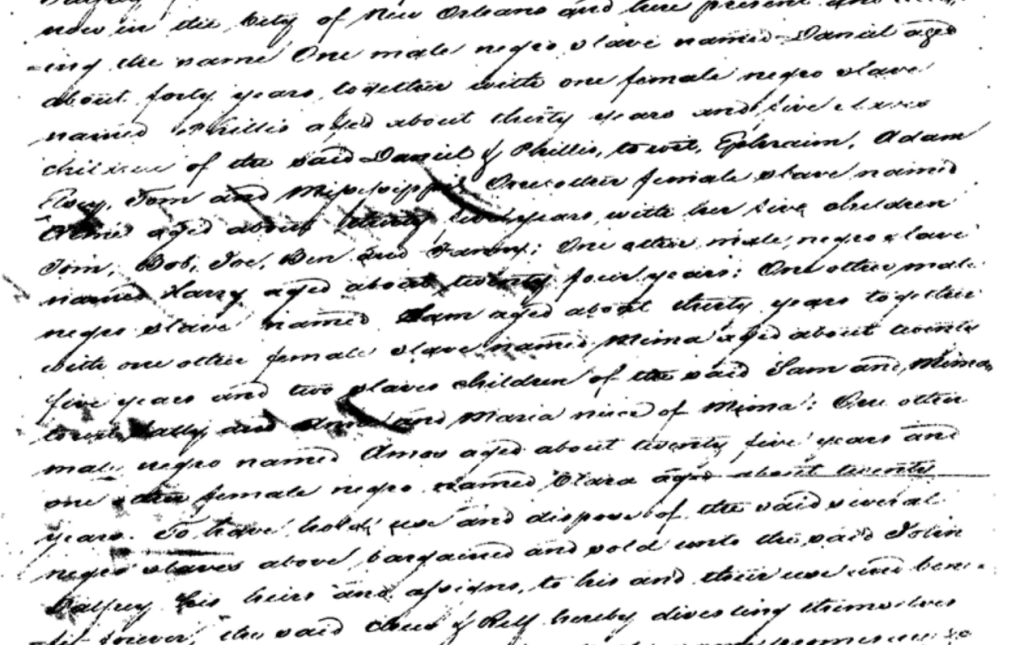
Sam and Mima were named in the March 9, 1811 purchase of slaves from Richard Relf and Beverly Chew by John Palfrey that included my Gibson family (Aime, Tom, Bob, Joe, Ben & Caroline) . An image of that sale is included below:


The transcribed text pertaining to Sam and Mima reads thus: one other male Negro slave named Sam aged about thirty years together with one other female slave named Mima aged abut twenty-five years and two slave children of the said Sam and Mima towit: Sally and Anna and slave Maria niece of Mima.

Sally was my 3rd great-grandmother. She and James Morgan were the parents of Ambrose Morgan, my 2nd great-grandfather. This means that Anna was my great-great aunt, making her children: Moses, Charles, William and Caroline and their descendants my distant cousins!!! I traced the Woodlins out of curiosity without knowing that they were DNA kin. And now I’ve found an Ancestry DNA match that includes those names!

Surprise of all surprises!!

Read about Sam and Mima’s grand children who were freed in 1843 and lived in NY, Michigan, Ohio and Kentucky.

Best,

What Became of Them?

My family tree includes Ambrose Morgan and Elsie Gibson.  I knew that Ambrose’s father was Jim or James Morgan and that Elsie’s father was Bob or Robert Gibson.  I knew that Bob had another daughter named Fanny, who had married William Marshall.  I knew that the Morgan, Gibson and Marshall families lived in St Mary Parish, because I’d found them on the 1870 and 1880 census pages.  Both Jim and Bob were born in Virginia in 1810 and 1800 respectively.  I wondered when and how they came to Louisiana.

And so, I looked among Freedmen Bureau records for Ambrose Morgan and William Marshall or their fathers.  I found men named Edmond, Jacob and Henry on a labor contract with William T Palfrey in 1867.  Also included was Jane, widow of Jerry.  All had the surname of Marshall.  Another work contract listed the names Ambrose Morgan and Billy Marshall.  That contract was with Joshua Baker.

My next search was for records on William Palfrey and family.  I found an 1843 St Martin Parish probate for John Palfrey.  William T Palfrey was listed among his descendants.  In the inventory portion of the probate, I found names of people from whom I descended: Jim and Ambrose.  

The probate seemed to be organized in a hierarchical manner.  The first names on the list were Amos 61, Clara 55 and her 9-year old son, ‘Little Amos’.  Following them were Billy 29, Edmond 27, Jerry 26, Patsey 23, Jacob 20, Henry 18, Newman 13, Richard 12, Polly 30, Perry 8, Clara 6, Edward 4 and Ben Smith 2 and Polly 10.  The list also included the names Jim 36 and Sally 37, who was listed as the mother of Minny 6, Haley 3 and Phoebe 1.  Following those names were Jack 16, George 13 and Ambrose 11 as well as Betsy 31 and child Ralph 5, Franky 11, Maria 22 and child Emily 2, Margery 20 and an infant child.  Jim, Sally, Minny (Mima) and Ambrose are my Morgan ancestors.

Based on the Freedmen Bureau labor contracts and the organization of the probate, I theorized that most of the names on the probate were one family—the Marshalls.

Listed on the 1870 and 1880 St Mary census pages were Jacob, Henry, Richard and Edmond Marshall.  Ambrose Morgan were listed in the same enumeration district in 1870 as William Marshall. Also listed was Minny “Mima”, wife of Jesse Hurst.  She was the daughter of James ‘Jim’ Morgan.  So, these people were a significant portion of those included on John Palfrey’s 1843 probate.

So, what had become of Amos, Clara and ‘Little Amos’ since 1845?  They could have been sold away from the other family or they could have died.  But, as I researched more into John Palfrey’s family, I learned that he had another son who lived in Boston.  This son, John Gorham Palfrey was reported to have freed the 20 slaves provided to him through the succession.  These slaves were reported to have been sent out of the state of Louisiana to Boston.  Were Amos, Clara and ‘Little Amos’ among those slaves freed?

After searching Ancestry.com, I found Amos and Clara Marshall on the 1850 US census living as free people in St. Martinville.  So, if Amos and Clara were freed, was ‘Little Amos’ also freed?  And had other people in the allotment to John Gorham Palfrey also been freed?  Could they be found in 1850 and after living in Boston?

An eleven-year old Amos was shipped from New Orleans to Boston on September 10, 1844 aboard the Bark Bashaw. The shipper was HW Palfrey. No other slaves were listed on the manifest with him. There was not a record of Amos Marshall, born in Louisiana, on the 1850 federal census in Massachusetts. But, there was twenty-five year old Amos Marshall living in Brooklyn, in 1860 in Kings County, New York. Amos’ birthplace was listed as Louisiana. His occupation was listed as a coachman. In his household was Sarah 22, who was born in Connecticut and children Albertina 2 and Annabella 1.

Amos, wife Sarah and daughters Albertina and Annabella were found on the 1865 and 1875 New York state census as well as the federal 1870 and 1880 census, living in Brooklyn. The 1870 census listed Amos’ occupation as a porter. He had personal property valued at $1000. The 1880 census was the first to include information on the birthplace of parents. Amos and his parents were recorded as all being born in Louisiana. Amos died in Feb 21, 1895. His estate was probated that year and listed his wife and daughters: Albertina B Marshall and Annabella Hunter.

So, now when I see DNA matches for people who live in distant states and whose tree’s never seem to intersect with Louisiana, I wonder if these people are of descendants of those who were freed before the Civil War and whose stories had been lost to us.  Or, if we are their descendants who were sold away.

So, what became of them is a question that I ask, but I imagine there are other people wondering the same about my branch on their DNA tree.

*******************************************************

Slaves Inherited by John Gorham Palfrey

I found a listing of the 20 slaves that were reported to have been inherited and then freed by John Gorham Palfrey who lived in Massachusetts. The list of slaves that he inherited are below. The highlighted names are of those that I have found living free in 1850 or beyond.

Anna 43 & her four children Mana (Moses) 9; Charles, 6; Caroline, 4; William, 2
Sarah, 11
Betsy, 31 and her child Ralph 5
Frankey, 11
Maria 22 and her child Emily, 2
Margery 20 and her infant child (Louisa)
Little Sam
Amos 61
Clara 55 and her child Amos, 9
Old Sam 65
Jose ‘Joe’ 40
Rose 12

*****************************************************

Other Freed Palfrey Slaves

Searches for other freed Palfrey slaves revealed possible matches for them in 1850. Four Black females, all born in Louisiana were listed on the 1850 East Boston, Ward 4, Suffolk County census living together. The household included Maria Marshall 28 and Emiley (sp) 8 and Margaret Jones 21 and Louisa 6. In their household was a 1-year-old Black male named Phillip. He was born in Massachusetts. Margaret and Louisa Jones could be the twenty-year-old Margery and infant. And Maria and Emiley (sp) are very likely the same listed in the probate.

Mariah Marshall died August 22, 1851 at the age of 30. Her place of birth was listed as Louisiana. The informant on her death certificate was Dr. Phineas M Crane. Her daughter Emily Marshall would have been 9 years old in 1851. I have not yet found her in Boston after the 1850 census.

Margaret Jones, Louisa Jones, 13; and Phillip Jones, 7; were again listed on the 1855 Massachusetts census. Included in their household was forty-year-old Elizabeth Smith who was born in Louisiana. Was this the thirty-one-year-old Betsy listed on the Palfrey probate? If so, where was her son Ralph, who would have been fifteen? Louisa’s mother Margaret and brother Phillip were not found in census records after 1855.

Mary Louisa Jones married Robert Bell on September 13, 1865. Her marriage certificate recorded her parents as John and Margaret Jones and his parents as James and Angelina Bell. Louisa’s birthplace was listed as New Orleans and Robert’s as Richmond, Virginia.

Louisa and Robert Bell and five-year old Francis were recorded on the 1865 Massachusetts census. Robert was a porter and Louisa took in washing. In the previous household was Lewis Garnett 63, a seaman and Elizh Garnett (sp) 52, born in Louisiana.

Louisa, Robert and Frank Jones were listed on the 1870 and 1880 federal census. The 1880 census listing for the household included: Louisa Bell, 37; Robert Jones, 30; Frank Jones, 20; and E. Garnet. E Garnet was listed as a sixty-four-year widowed old aunt, who worked as a nurse and was born in Louisiana. Is this E. Garnett the same as Elizabeth Smith on the 1855 census and the Elizh Garnett on the 1865 census. Was E Garnett the 31-year-old Betsy listed the 1843 probate? Louisa and family lived at #3 Strong Place near Cambridge Street, the current-day Beacon Hill neighborhood of Boston.

There is a death record for Elizabeth Garnett. She died in 1888 and was listed as a seventy-eight-year-old widow who was born in New Orleans and worked as a cook. Elizabeth died in the Aged Colored Women’s Home in Boston. Her parents’ names were recorded as Samuel and Almira. Wouldn’t it be something if Samuel and Almira were indeed Sam Riggs & Mima!!

Frank Bell was not located on census records after 1880 or in death records. Robert, Louisa and daughter Lillie M Bell were counted on the 1900 Boston, Massachusetts census. Mary L Bell and daughter Lillie M were listed on the 1910 Census. Mary was widowed and worked as a domestic. Mary L Bell, nee Jones died 1918.

******************************************

The last possible match that I’ve found is a seventy-year-old Black man named Sam Riggs. He was listed on the 1850 Fausse Point, St Martin Parish census in the household of Henry Dorsey. Sam Riggs matches the sixty-five-year-old Sam from John Palfrey’s 1843 probate. Henry’s parents were Catherine Riggs and John Dorsey. Catherine was born about 1805 to Abraham Riggs of Accomack, VA and Elizabeth Byrd. I haven’t been able to determine if Sam had a connection to the Riggs/Dorsey family before he was freed in 1843 or how he came to live with Henry Dorsey. Sam’s death was recorded in William T Palfrey Plantation Diary, “April 8, 1862, Negro man Sam (free) died.”

******************************************
I hope to continue the search to see what became of other slaves freed and their families.

Read About the Morgan, Riggs and Gibson Women on My Family Tree

Best,

Design a site like this with WordPress.com
Get started