Louisiana, Maryland, Virginia and Carolinas African American Genealogy Research
Author: Faye Hayes
I started my genealogy journey looking for anyone who had Robert Jenkins and Bridget Guy on their family tree. Almost immediately, 2 unknown cousins connected via e-mail and began sharing stories. It became clear that we knew a few things about the Jenkins branch of our family tree and knew almost nothing about our Smith branch. This blog will share information of my search for Jenkins, Guy, Smith and now Phillips, Torney and Watts people on the branches of my family tree--Maryland to Louisiana!
Join me on the journey!
Martin Guy was a man on my family tree for whom I have found many descendants, but a man who I have not been able to find on any census record. Martin was the son of George and Jenny Guy. Most of what I know Martin Guy is through marriage records of his son Ezekiel George Guy and by way of Ezekiel’s civil suits for recovery of property owned by his deceased siblings, Abram and Maria Guy.
The beginning of what I know about Martin’s story is that his father George was a slave on the plantation of William Weeks sometime before 1817. On Oct. 2, 1817 William Weeks sold George and at least 48 other slaves to his son David Weeks. The sale was recorded in West Feliciana Parish, Louisiana, Parish Book A, Folio 491-492. In a separate recording of that same sale (Afro-Louisiana History and Geneaology), George was listed as George Elivin. This was a transcription error–George was valued at eleven hundred dollars. Two females named Jenny were sold in 1819 by someone by the last name of Weeks, most likely William Weeks who died Oct. 22, 1819 in St Francisville, LA. The sale is recorded in Estate Number: 26-A-088-033-1819.
George was recorded as a fifty-five-year-old Mulatto driver on David Weeks’ 1835 probate. Jenny, age thirty-four, is listed as his wife. Listed with Jenny are children Amanda, 9; George, 7; Abraham, 5; Lewis, 4; and Martin 1. Listed on successive lines beneath Jenny are Isaac, 17; Nancy, 15; and Bridget, 12.
Martin, 12 next appears in the 1846 final partition of David Weeks’ estate. He along with brothers, Lewis and ‘Little Abram’ as well as parents George and Jinny (Jenny) were among the slaves in the allotment given to Harriet Weeks Meade.
Charles C Weeks and his siblings took large numbers of slaves to Texas in 1862 or 1863. They each took slaves to different counties in Texas and hired them out to work; in fields, for the railroad and to haul products as far away as Brownsville and Mexico. Martin was mentioned in Charles Weeks’ April 28, 1864 letter. Weeks wrote that he had secured a contract to haul bacon to Shreveport when one night, Martin, Milton and Ben left him near Homer in Angelina County, Texas. Apparently, they ran away. Martin, Milton and Ben must have been drivers, because Weeks next wrote that he “hired two white drivers & drove the third wagon myself.” Weeks also wrote that he’d learned that “one of his Negroes were in jail” but that he did not know where. He did not seem to know which of the 3 men was jailed. I have looked for Martin in Texas and Louisiana in 1870 and onward but have not yet found him.
I have found his children: Abram, Ezekiel, Maria and Milry Guy on the 1870 Iberia Parish census. Abram Guy, 15 was listed in the household with his grandparents Sommerset and Peggy Furnice. Sommerset and Peggy had several daughters: Eliza, Minerva, Minty, Amy and Leah. I have not been able to determine which of these was Abram’s mother.
Abram Guy married Mary Johnson or Asbury. They lived in Rosetown and were included in the 1880 Iberia Parish census with children: Patsy, 6; Henry Handy, 4; and Martin, 1 month. Abram and wife were recorded on the 1900 census. Census data noted that they had been married for twenty-seven years. Included in the home were children: Virginia, 17; Hester, 12; and Martin, 18. Also in their home was granddaughter Stella, 5. Neither Abram or Mary could read or write but all of their children were able to do so. Abram worked as a ditcher and owned his home.
Abram had mostly likely died by 1910 as his son Martin Guy and wife Gertrude were listed on the 1910 census living in the residence where Abram previously had owned between Polite Joseph and Raymond Antoine. Included in Martin’s home in 1920 were children: Bertha, Louisa and Robert.
Ezekiel George Guy, 11 was recorded in the home of his aunt Amanda Guy and her husband Jacob Williamson for the 1870 census. Ezekiel’s 1895 New Orleans marriage license listed his parents as Martin Guy and Patsy Ly?? He married Mintie Young, daughter of Henry and Celeste Young. He and wife Mintie were included in the 1900 US census in New Orleans with daughters, Celeste, Mary and Katy. Ezekiel worked as a day laborer and lived at 414 Burgundy Street. He and Mintie were able to read and write.
Ezekiel married Estella Haywood in 1907. His name on the license was recorded as George Guy and his age as forty-one. His parents’ names were recorded as Martin and Patsy Guy. Ezekiel and Stella and appeared on the 1910 LaFourche Parish census with their son George. Ezekiel was listed as George Guy and worked as a bricklayer. He and Stella were still in LaFourche Parish at the time of the 1920 census. Included in their home were George, 11; Octavia, 9; Samuel, 7; Armour, 4; Clarence, 2; and Hazel, 1.
By 1930, Ezekiel was back in Iberia Parish. He was recorded as a seventy-year-old married man. Estella and children were counted on the 1930 Orleans Parish census. Estella was listed as a widow.
Estella and family moved to Pasadena, California and were listed on the 1940 census. She worked as a cook and lived 544 W. Pepper Street. Ezekiel and wife Katie Rose were listed on the 1940 Iberia Parish census.
Ezekiel filed in civil court to obtain the property rights of his deceased siblings Abram and Maria Guy. In one of his filings, he included the name of former wife Estella Haywood. Ezekiel died June 19, 1944 in a Lafayette hospital. Ezekiel’s granddaughter Octavia Estelle Butler was a highly regarded science fiction writer of works such as Kindred, Bloodchild and Fledgling. She also received the MacArthur Foundation “genius” grant.
Maria Guy was born about 1858 to Martin Guy and Charity. She was listed on the 1870 Iberia Parish census in the household of Emus and Charity Spahe along with Anna and Josephine Gatewood. I know that Maria Guy purchased land from Mrs. Emma Henkle April 1900, Book 38, Folio 138, but I have been unable to find Maria on any census after 1870.
Henry Jenkins was my 4th great grandfather. He was born about 1860 and was the youngest child born to Bridget Guy and Robert ‘Bob’ Jenkins. As I’ve written in previous blog posts, it has been difficult to research Henry because I have not been able to find him in the 1880 US census and I have only found 1 marriage record for Henry–his 1898 marriage to Mary Mathieu.
Henry was recorded as the father of several children: Simon Felix, Oliver, Victoria, Louisa, Henry Jr., Matthew, Lloyd, Profit, Clarence, Agnes, Mary and Maviola. He was recorded on the 1900 US census, living in St Mary Parish, Ward 7, with Mary to whom he’d been married 2 years. He was listed as John Jenkins, instead of Henry. Included in their household were: Victoria, 7; Louisa, 5; and Henry, 3.
The 1900 census added the question regarding how many children a woman had given birth to and how many of those children were still living. Unfortunately, there is no way to determine how many children Henry or any man may have fathered. I obtained social security card applications for 2 of Henry’s sons; Simon Felix Jenkins and Henry Jenkins Jr. This provided me with the names of Henry’s 2 wives: Elsie Edwards and Madeline Charles. As mentioned in an earlier post, I believe that Henry’s earlier wives may have died shortly after giving birth. I could only find Elsie (Alcee) Edwards on the 1870 Iberia Parish census. I found a Madeline Charles on the 1870 St Mary Parish census, but have not been able to determine if this person was the mother of Henry Jenkins Jr. and presumably Victoria and Louisa as well, since both were older than Henry Jr.
According to the 1900 census, Henry worked as a day laborer who owned his own home and could neither read or write. Information was provided to the census taker that Henry’s parents were both born in Maryland, despite the fact that his mother, Bridget, was most likely born in St Mary Parish. Bridget’s parents’ place of birth was recorded as Maryland on 1880 census and as Louisiana and Virginia on 1900 census. That Maryland was listed as Henry’s mother, Bridget’s birthplace may indicate that he was aware of a connection to a Maryland ancestor.
Census data for 1910 Census data recorded Henry’s answer that he had been married 3 times. Henry, Mary, Louisa, Henry Jr as well as 3 children born since the previous census: Matthew, Lloyd, Crawford (Profit), were living together in St Mary Parish, Ward 7. Henry’s employment status was recorded as ‘working out‘ and he was described as a ‘renter’ and not as owner as he was per the 1900 census. I will see if I can find out if the term ‘working out’ meant that Henry was paying off a debt and that is the reason for the change in his home ownership status.
Missing from Henry’s 1910 household was daughter Victoria. I have not found Victoria on the 1910 census, but I know that she married Matthew Schaffer. I found a death record for a child born in 1915 to Victoria Jenkins and Mat Schaffer. I did find Mat Chaffer (Schaffer) listed on the 1910 St Mary Parish census as a twenty-seven-year-old man who had been married for five years but there was no listing for a wife in his household. Mat worked as a railroad laborer. All branches of my family tree originated from enslaved people that lived in Iberia and St Mary Parish. Because of this, I think it is inevitable that marriages would occur between the 2 branches. I have not been able to say definitively, but I theorized that Mat Schaffer was the eighteen-year-old Matthew Smith who was recorded in the home of Joseph and Charlotte Smith (my maternal 3rd great grandparents on my Smith tree) on the 1900 Iberia Parish census.
Henry and Mary were still living in Ward 7 at the time of the 1920 census. Four more children were recorded in their household: Clarence, Agnes, Maviola and Mary. The family lived on Pepper Road in a home that per the census was rented. No person in the household was recorded as being able to read or write. Henry, Mary, Matthew, Lloyd and Profit all worked as farm laborers.
Henry’s daughter Victoria , 25 and husband Matthew Chaffer, 31 (Schaffer) were recorded on the 1920 St Mary Parish census living on Jefferson Highway. Living with them were children: Beatrice, 8; Liza, 6; and Cigas, 1. The household listed next on the census included Matthew’s aunt Cora Smith. That household included Jack Elware, his wife Cora, his nineteen-year-old stepdaughter Agnes Robertson and his sixteen-year-old daughter Alma.
Henry’s son Felix and wife were living in Beaumont at the time of the 1920 census. Felix worked as a shipyard laborer and his wife Mary as a cook for a private family.
As I mentioned previously, Henry’s son Oliver Jenkins, wife Amelia Smith and family were missing from the 1910 and the 1920 census.
I have not yet found Henry’s daughter Louisa on the 1920 census, but I did find her on the 1930 St Mary Parish census living in the household with her in-laws, Thomas and Lucy Volter. Also living there were Louisa’s children Jacob, Thomas and Moses.
Henry died October 21, 1925. His age was recorded as seventy, suggesting that he was born in 1855. The information regarding his parents was recorded as unknown. The informant for the death certificate information was Henry’s son-in-law Nathan Volter. Henry’s burial place was ‘near Jeanerette’.
Henry’s daughter Victoria Jenkins Schaffer died Aug. 1, 1921 of breast cancer. Her place of death was listed as Albania. For the 1930 census, Victoria’s children Eliza Schoffer (Schaffer), 15; and Cedgis Schoffer (Schaffer), 11; were recorded in the household with their aunt, Cora Henry. Also in the home was Cora’s husband Jack Henry and her 6-year-old grandson LeRoy Thomas.
Henry’s widow Mary, son Clarence and daughter Maviola were living together on 1930 St Mary Parish census in Ward 7 in a home that they owned per census records. Both Clarence, 18; and Maviola 11; could read and write. Fifty-two-year-old Mary and Clarence worked as farm laborers. Living with Mary was daughter Agnes, her husband Charles Wesley and their son Henry.
Henry’s sons Matthew and Lloyd were married and living in Texas by 1930. Matthew Jenkins and wife Viola LaFleur were living in Jefferson County. Lloyd Jenkins and Ida Griffin were married 1929 in Harris County, Texas.
Henry’s son Oliver Jenkins and wife Amelia Smith who had were missing from the 1910 and 1920 US Census, miraculously were recorded on the 1930 Iberia Parish census. Their household included Oliver, 52; Media, 42; Livingston, 17; Olie (Oliver), 12; Solomon, 6; Charlotte, 15; and Cora, 10. Solomon was not Oliver’s son, but his grandson. Solomon’s mother was Elsie Jenkins. Olie (Oliver Jr.), Charlotte and Cora were recorded as being able to read and write. Oliver and Amelia’s children: Elzenia, Florence, Elsie, Gladys and Austin had all married and were living in their respective households in Iberia Parish and in California.
If you have been following my genealogy trek to find my early ancestors, you know that telling Amelia and Oliver’s story has been complicated by the fact that Amelia’s parents were missing from the 1880 census records as were Oliver, his brother Simon Felix and his father Henry Jenkins, Sr. Additional complications to telling Oliver’s story was that his mother, Elsie Edwards most likely died soon after his birth in 1878 and Elsie’s parents, Handy aka Anthony and Versy aka Olivia Edwards, were missing from the 1880 census as well. It is only because I found Simon Felix Jenkins social security card application that I know the name of his mother. Felix died in 1941, but not before he applied for a social security card in 1935. That application gathered information supplied by the actual applicant and is often the only time we find the maiden names of mothers. When Felix died in 1941, his half-brother Matthew Jenkins provided the name of Henry Jenkins as Felix’s father for the death certificate but said that the mother’s maiden name was unknown.
One of the greatest unknowns about Amelia and Oliver is where they and family were for the 1910 and 1920 census. I spent a great many unsuccessful hours sitting at genealogy libraries, painstakingly turning the microfilm reader wheel slowly, looking at every frame hoping to see the family. I used every genealogy search engine–searching for near matches on variations of their names. I searched for them living in different states but still didn’t find them until 1930.
In 2012, I found a book written by Amelia and Oliver’s granddaughter, Leanna Williams that detailed the family’s life in The House Surrounded by Sugar Cane. She painted a vivid and inspiring glimpse into our shared family story. She described the house as being situated at the end of a road, separated from the quarters where other plantation workers lived. She told of the many fruit and nut trees that surrounded the house in addition to the acreage devoted to food crops and to truck farming. So, I thought that perhaps census workers overlooked the house when on their rounds. Perhaps the road was too muddy or the house too isolated and so the house was skipped? But Leanna also wrote that an uncle named David and his wife Sarah had lived in the house and it was only after Sarah’s death did her father Livington Jenkins and family move in to help him with the farm. She placed the family moving in with David sometime shortly after her sister Theresa was born. That would have been about 1933 or so.
This confused me because Amelia and Oliver were still alive in 1933–why weren’t they living in The House Surrounded by Sugar Cane? I’d theorized that Sarah Smith and her husband William Davis were actually the Sarah and David mentioned in Leanna’s book, but they were living in New Iberia at the time of the 1930 census. Sarah died in 1939 and by 1940 William was living in Patoutville, which is where the family farm was located.
Did Amelia have a brother named David? Answering that question is a unanswered puzzle. Amelia was born about 1881 or so and first appeared on the 1900 Iberia Parish census. 1900 census data revealed that Amelia’s mother Charlotte had given birth to fifteen children of which 9 were still living. The problem is that through all of my research, I can only account for eleven children, living or deceased: Maria, Eliza, Ida, Lincoln, Louvenia, Ella, Charlotte, Oliver, Sarah, Amelia and Cora. Four of Charlotte’s children: Maria, Eliza, Ida and Lincoln were never seen after the 1870 census. Were any of these 4 children alive somewhere. I have only found 7 of the 9 children reported to be living in 1900: Louvenia, Ella, Charlotte, Oliver, Sarah, Amelia and Cora. After more thinking, I wonder if Charlotte was counting among the 9 living children, her daughter Charity who lived in Maryland? Charlotte had been born in Calvert County, MD and then sold and shipped to Louisiana in 1851?
I tossed out my assumption that Amelia and Oliver were not listed on census records in 1910 and 1920 because they were living in The House Surrounded by Sugar Cane. My focus now was on their children and on what became of them. I want to tell know their stories! I know some of their descendants moved to Texas, California and Arizona. But I suspect that we, the Guys/Jenkins/Bernards/Charles/McGees, are out there in every state, county and continent on this great earth!
Amelia and Oliver’s children
Elzenia Jenkins 1901-1952 Iberia Parish, LA & Louis Newchurch
Florence Jenkins 1905-1961 Shasta County, CA & Sidney Benjamin
Gladys Jenkins & Polite
Elsie Jenkins & Ivory Hills
Austin Jenkins 1913-1986 CA & Corinne Rosette 1912-1984 AZ
Livingston Jenkins & Reverta
Charlotte Jenkins & Andrew
Oliver Jenkins Jr. & Sarah
Cora Jenkins & Phillip
And so, I invite everyone who is a descendant of Amelia and Oliver to join me in gathering stories and photos as well as celebrations of birth and of lives well lived. I hope you join me if only to ask a question.
I was able to add branches to my Calvert County, Maryland families: the Phillips, Torneys, Watts, Taylors, and Kents, thanks to Ancestry.com shared profile matches and Gedmatch.com’s DNA chromosome comparison tool. The problem I faced was that I’d found Joseph aka ‘Young’ Smith and Charlotte on the 1870 census but had not been able to find them on the 1880 census. I did not find them again until the 1900 Iberia Parish census. In thirty years their children had grown up, married and moved out and started lives of their own.
Living with Joseph Smith and Charlotte Phillips in 1900 was nineteen-year-old widowed Amelia Smith, who according to census records had given birth to 1 child. In that household also was fifteen-year-old Cora Smith who was also widowed and the mother of 1 child and Alava Smith who was twenty-two years-old and married for 2 years. In the household also was eighteen-year-old Matthew Smith and 2 children age 1: Clarance and Agnes. Finding those children previously listed on the 1870 census: Maria, Eliza, Ida, Lincoln, Lavinia, Lincoln and Ella proved to be challenging.
Adding to the challenge was that according to the 1900 census, Charlotte had given birth to fifteen children, of which 9 were still living. Adding the 7 children listed on the 1870 census to the 3 listed on the 1900 census brought the number of children known to me to 10. So, there were 5 children whose names I did not know. Joseph was born in Kentucky and Charlotte in Maryland, so I looked in houses near them on the 1900 census for people with the correct names whose parents were born in those 2 states. I did not find any.
I looked at Familysearch.org for marriage and death records for all of the children from the 1870 census and found only 1 marriage but no death records. I found an 1882 marriage record for Lovina Smith to Charles Jean Louis. The witnesses were Alfred Spencer and ??? Coleman. J.B. Livingston was the minister. Was this my Lavinia?
I then searched among the death records for Joseph Smith in Iberia Parish and found a 1939 death record for Sarah Smith Davis. Her parents were recorded as Joseph and Charlotte Smith. I had never seen the name Sarah, but I’d now found 1 of the missing 5 children. I scrolled down and found a record for Ella Louise Johnson who’d died in 1949 in Lake Charles, Louisiana. The certificate listed her parents as Joseph and Charlotte Smith.
I next searched in death records for Young Smith and found documentation for 2 of the 3 children listed on the 1900 census: Amelia Jenkins’ 1948 death in Iberia parish and Oliver Smith’s1930 death in Port Arthur. I still had 4 unknown children of Charlotte’s to find.
Searching on the name of the newly found child Sarah Smith, I found several Sarah Smiths living in St Mary and Orleans Parish for 1900. I looked at each one until I found a likely match–a Sarah Smith living on Eralto Street in New Orleans, Ward 2 in a rooming house with Lavinia Marshall 28 and her forty-year-old husband Nathan Marshall with whom she’d been married for 2 years. Also in the household was Priscilla Ely, 10. Sarah’s age was incorrectly transcribed as 3 even though the census taker wrote her birth information as Oct. 1876, which would have made her about 23. So, I had now found Lavinia and Sarah Smith as well as Lavinia’s daughter Priscilla.
Lincoln Smith
Lincoln Smith was a very hard person to track. I actually only found him alive on the 1870 Iberia Parish census when his age is listed as 5. I was not able to trace Lincoln or his family until 2018 when I found information on the auction and sale of the Young Smith Estate. Young and Charlotte purchased the land in 1872 from Lassoline Bonin and wife Cecile Broussard. I knew that the family had lost the land sometime about 1969 from parish tax assessor information and through records obtained from the Iberia Parish Court House. So, I looked in Iberia Parish Courthouse records online and searched on the name Young Smith and Joseph Smith. I found royalty payments from Dunlap Oil to descendants of Young Smith. Among the newly discovered names were: Lawrence Jacob; Pearl Smith Eglin, wife of Philip Eglin; Lizzie Walker, wife of Joseph Walker; Oscar Smith and Mamie Tibbs Hart.
So, I now had new names to research!
I found Lawrence Jacobs listed on the 1910 Calcasieu Parish census with his mother Lizzie Jacobs, a thirty-five-year-old widow and children Charlotte 26, David S 21, Alfred 10 and Lawrence 7. I searched the 1900 US census and found Lizzie Jacobs in St Mary Parish with her husband of 5 years, Alfred Jacobs. In that 1900 household were 2 older children: David 12, Charlotte 14. I assumed these 2 children were Lincoln’s children, because Lizzy had only been married to Alfred for 5 years. So, I looked for a marriage record for Lincoln Smith and Lizzie. I didn’t find one, so I looked for death records for David S Jacobs and his other siblings. I found a 1939 Beaumont, TX death record for David Lincoln Smith which listed his parents as Lincoln Smith and Lizzie Porter. David was born Feb. 15, 1892 in Jeanerette. All of the other children of Lizzie Porter took Jacobs as their last name.
Lizzie’s daughter, Charlotte Jacobs married a man named Julius Paul. She was listed on the 1910 Calcasieu Parish census twice; once with children Edward Paul, 8; and Lizzie Paul, 6. She was also listed as Charlotte P in the household with her mother Lizzie Jacobs. Charlotte Smith Jacobs Paul Lovett died 1937 in Calcasieu Parish. Lawrence Jacobs was a child of Lizzie Porter and was included in the estate of Young Smith. He and family lived in Beaumont until 1940. His family was included on the 1950 San Francisco census. I have not obtained any further information on Lawrence regarding his parentage.
The Lizzie Walker listed as recipient of Dunlap Oil royalty payments from the Estate of Young Smith was in fact Lizzie Paul, the daughter of Charlotte Jacobs Paul Lovett. Lizzie later married Jack Walker and continued to live in Lake Charles until her death, April 19, 1969. She was buried in Combre Memorial Park Cemetery.
I will stay on the look-out for information of any Lincoln Smith born about 1865 in Louisiana, but only as a back-burner item. Sometimes women and men say that that are widowed not because they actually are, but because they don’t know the location their husband or wife!
Sarah Smith Davis
Sarah had been in New Orleans in 1900 but must have returned to Iberia Parish soon after because I found an Oct. 10, 1905, marriage record for Sarah Smith and William Davis. Witnesses to the marriage were Thornton Tibbs, Pierre Domingue, Jr and Loulia Thompson. S (Stephen) Tillman married the couple. The 1910 US census recorded Sarah, husband William Davis and 3-year-old son William living in St Mary Parish, Ward 3. Census data indicated that Sarah could read and write, but that William could do neither. The family was next listed on the 1920 St Mary Parish census living on Alice B. Plantation Road. By 1930 Sarah and William had moved to New Iberia. The US census listed them at 537 St. Peter Street. The family of Celestine Bernard was also listed at that address. It is possible that William and Sarah lived in a rental unit adjacent to or in the rear on the property. William was sixty-nine years old and Sarah was fifty-nine. Census data recorded that Sarah as first married at the age of twenty-five and that William’s first marriage was at the age of nineteen. This indicated that his marriage to Sarah was perhaps his second marriage. Their son William Davis was not listed in their household for 1930.
Sarah died March 13, 1939. Her age was recorded as sixty. Sarah’s husband William was listed on the 1940 US census living Patoutville, Iberia Parish. According the Leanna Williams in her book, The House Surrounded by Sugar Cane, her parents Livingston Jenkins and wife Reverta moved into the home to take care of her Uncle David following the death of his wife Sarah. David was thought to be the brother of Amelia Smith, Livingston’s mother. I believe that the uncle Leanna wrote about was actually William Davis, husband of Sarah Smith.
Sarah’s son William Davis registered for WWII in Maringouin, Iberville Parish, LA. Interestingly, his birth date was recorded as May 8, 1896 in Patoutville, although he first appears in Sarah’s house as a 3-year-old on the 1910 census. On the registration, William’s nearest relative is recorded as Rosa Christian whose address was 540 St. Peter Street in New Iberia. I believe that William mistakenly reported his year of birth on all public records. His father, forty-five-year-old William Davis appeared on the 1900 Iberia Parish census with wife Mary and children: Allen 17, Rosa 12, Junius 6 and Samuel 3. Per census data, William’s wife Mary had given birth to 4 children, all of whom were still living. There was no child name William in this 1900 household suggesting to me that William Davis Jr. is the son of Sarah and William and the same son listed on the 1910 and 1920 census living in their household.
I found William Daniel Davis‘ name on the 1969 disposition of the Estate of Young Smith. William’s address was Maringouin, Louisana. I found him on the 1950 US census living on Gross Tete Bayou Road in Maringouin, Iberville Parish with wife Stella Winsey. Census data recorded that he worked on a cattle farm for sixty hours per week. His Nov. 1993 death records indicates that his parents were William Davis and Sarah Smith. I did not find any children for William Daniel Davis.
Louvenia Smith Marshall Perkins
Lavina (Louvenia) was in New Orleans for the 1900 census but in Calcasieu Parish for the 1910 census. In her 1910 household was: husband JA Perkins,39; daughter Effie Perkins, 9; son-in-law James Williams, 29; married daughter Priscilla, 19; and grandson Lee Howard Williams, 2. Everyone in the household could read and write with the exception of Lee. Census records indicate that JA Perkins owned his home.
Luvenia and Effie were listed on Calcasieu census records living together through 1930. Louvena is living alone by the 1940 census. Her death certificate records that she died Oct. 19, 1947 and that she was born in St Landry Parish. Her daughter Effie Perkins provided the names for Luvenia‘s parents: Joseph and Celeste Smith. The death date, (1947), on Luvenia’s death certificate is very interesting, because Luvenia was listed as a seventy-eight year old widow on the 1950 Chicago, Ill US census living in the household of John M, Luvena and Lee H Perkins.
I could not find Priscilla Perkins, husband John M Williams and Lee Howard on the 1920 census but was able to find them for US census years 1930-1950 living in Chicago. Per the 1930 census, John worked as a mechanic at a garage and Lee Howard as a laborer at a tractor company. The family lived on E. 43rd Street. By 1940 John’s occupation was sewer construction. He and Priscilla lived at 4212 Wabash Ave. The 1930 census data reported that everyone in the household could read and write. Priscilla’s death records her birth as Oct. 20, 1890, in Jeanerette and her death as Jan. 31, 1957.
Lee Howard Williams was born 1907 Lake Charles, LA. The WWII draft registration form described him as 5′ 8 1/2″ with a dark complexion. He was married twice. He and first wife Ruth Evelyn Harris had at least one child, Joy Lavern Williams. His second wife was Hibernis Dangerfield. Lee worked for International Harvestor and lived at 25 E. 23rd Street per the 1950 US census.
Louvenia’s daughter, Effie married Paul Lewis and was listed in the 1961 obit for stepfather James Perkins. That James died after Luvenia told census takers that she was a widow, highlights a thing that I’ve seen over and over again–people often record their marital status as widowed when they were most likely abandoned by a living spouse or separated and not divorced.
Mariah Smith Williams
Maria or Mariah Smith was born about 1854. I only found her on the 1870 Iberia census living with parents Joe and Charlotte Smith. What little I know of Mariah has been gleaned from other family member trees and through limited conversations with cousins. What I’ve been told is that the 1-year-old boy, Addison, listed on the 1870 census was not the son of Joe & Charlotte, but instead the son of sixteen-year-old Maria. Addison’s father was Peter Williams. I have not been able to find any records for Peter Williams and have not been able to trace Maria after the 1870 census.
Mariah’s son, Addison Williams was married twice, once to Alice Mary James. Their children were Sanders James 1896-1936 and Matthew James. His second marriage to Mary Nancy Turner produced at least 6 children: Tarleton, Timothy, Trinity, Sedonia, Beulah and Josephine.
Ella Smith Johnson
With newly found information, I was able to find Ella and husband Tom Johnson on the 1900 Iberia census with their sons: Edward, Abraham Lincoln ‘Foote’, Albert and Joseph. Ella and family were later found on the 1910 census and later years in Calcasieu Parish. Ella died 1949 In Lake Charles, LA. Her death certificate indicated that her father Joseph Smith had been born in Frankfurt, KY and that her mother’s name was Charlotte Smith. She was buried in East Side Cemetery. The informant was A.L. (Abraham Lincoln) Johnson.
Ella Smith’s Descendents:
Albert Johnson and Eva Woods ->Albert, Wilmer, Geneva, Curtis, Mary L and Victoria
Abraham Lincoln Johnson 1890-1964 Galveston adn Serena Washington ->Floyd, Lloyd, Abraham Lincoln, Fabiola, Leolo, Gracie Mae and Frankie
Joseph Johnson 1898-1963 Port Arthur & Blanche ->Ella Johnson born 1916
Edward Johnson 4/3/1890 Patoutville – 1972 Served as a Private, Co B, 522 Engineers Service Battalion, shipped out of Hoboken, NJ on 4/8/1918 on the Susquehanna and returned to Newport News on the USS Siboney on 6/3/1919
Charlotte Smith and Thornton Tibbs
I found an April 1, 1895 marriage record for Charlotte and Thornton Tibbs. Witnesses to the marriage were Charlotte Alexandria and William Metts. When I re-examined the 1900 census page that listed Joseph and Charlotte Smith and family, I now noticed that Charlotte and Thornton Tibbs were also listed on the same page with a 4-year-old daughter May E. The same family group was recorded on the 1910 census. By the time of the 1920 census, the household included a 5-year-old daughter named Thelma. Also included in the home was Charlotte’s sixteen- year-old niece, Florence Jenkins (Amelia Smith Jenkins’ daughter).
Charlotte’s daughter May appeared on the 1920 census as Mamie Self, married and living in Longville, Beauregard Parish, LA. I found a marriage announcement in the Era-Leader (Franklinton, LA) June 2, 1921 for Mamie Tibs and Henry Hart.
Charlotte, Thornton and family had moved to Bogalusa, Washington Parish by the time of 1930 census. Thornton worked at sawmill and the family lived at 620 Avenue S. Census data recorded that the family did not own a radio and that Thornton was married at the age of eighteen and Charlotte at the age of fifteen.
The 1940 US census recorded Charlotte, Thornton and children Thelma, Herman and Joy Dee living in Bogalusa, LA. I found something interesting in education data for the family. Charlotte had 2 years of high school education and Thelma 1 year. Thornton had a 3rd grade education and Herman a 6th grade education. Charlotte died Sept. 24, 1941 in New Orleans. The certificate recorded her father’s name as Joseph Smith. Thelma, husband Forest Whitaker and her father were listed on the 1950 US census still living at 620 S. Avenue S.
Mamie Tibbs 1896-1964 Bogalusa, Washington Parish, LA and Henry Hart
I first found Oliver on the 1900 Iberia Parish census recorded as Alava Smith, living with parents Joseph and Charlotte and his sisters, Amelia and Cora (Clora). His marital status was married for 2 years, but there was no woman included in the household with him that appeared to be his wife. I searched census records again and found another result for an Oliver Smith living in St Mary Parish. The St Mary household listed Oliver Smith, 21, married 2 years. Also listed in the household was Alzina Griffin Morris, 20, married 2 years and a 5-year-old Elsie Smith. I assumed the Alava Smith in Iberia Parish and the Oliver Smith in St. Mary Parish were the same man.
My assumption was proved to be correct. Listed on the 1910 US census living in St Mary Parish were: Oliver Smith, wife Elzenia, eight-year-old daughter Pearl and stepdaughter Elsie Haywood. Oliver, Alzena and Pearl were listed on the 1920 Jefferson County census living in Port Arthur, TX.
Pearl Smith and husband Philip Eglin were listed on the 1930 Jefferson County, Port Arthur, TX. They were still living in Port Arthur at the time of the 1940 census with son Theaphlus.
So, now I’d found eleven of fifteen children born to Charlotte Phillips and Joseph a.k.a. Young Smith. Charlotte’s known children now included Mariah Smith Williams, Eliza Smith, Ida Smith, Louvenia Smith Marshall Perkins, Lincoln Smith, Ella Smith Johnson, Oliver Smith, Charlotte Smith Tibbs, Sarah Smith Davis, Amelia Smith Jenkins, Cora Smith Henry.
I am not able to definitively say that I’ve found Eliza or Ida Smith after the 1870 census. I have several DNA matches who have an Ida Smith at the top of their maternal family lineage. I have not yet figured out the names of Ida’s parents. Ida was listed on the 1900 census in St Mary Parish with husband Jim Hines and children: Beulah, Pearly and Elias Johnson as well as 1-year-old son Joseph Hines. Ida most likely died between 1900 and 1910. The only child of Ida’s that I have been able to positively identify after 1900 is her daughter Beulah Johnson. Beulah was recorded on the 1910 US Census living with her stepbrother James Robinson, age twenty-five. Beulah married Horace Yelling and it is her descendants that are shared DNA matches a number of key Maryland descendants of Eliza Phillips Torney. Beulah’s death certificate listed her parents as Ida Smith and Jim Key.
I am on the lookout for the names of Charlotte Phillips’s 4 remaining unnamed children. At the time of the 1900 census, it was recorded that she given birth to fifteen children of which 9 were still living. Seven of those 9, that I know were alive in 1900 were: Amelia Smith, Charlotte Smith Tibbs, Ella Louise Smith Johnson, Louvenia Smith Marshall, Oliver Smith, Sarah Smith and Cora Smith. Who were the remaining 2 that were living in 1900? Was it Mariah, Eliza, Ida or Lincoln?
Bridget Guy and her union with the mysteriously invisible Robert aka ‘Little Bob’ Jenkins
He was referenced as ‘Little Bob’ because there was an older man on the Weeks’s plantation named Bob. I haven’t found any description of Bob to otherwise explain the diminutive.
In fact, I have not found Robert Jenkins alive on any census. He was listed on David Weeks’ 1835 probate as Bob, twenty years old. On the following line was Hannah, 18, wife of Bob. Twelve-year-old Bridget was included in that same probate.
A thirty-one year old Bob was listed in the partition of slaves allotted to Alfred Weeks in the 1846 finalization of David Week’s probate. Included in that partition is Bridget 23, and children Nancy, 7; Emily, 4; and Isaac, 1.
Hannah, previously listed as Bob’s nineteen-year-old wife may be the Hannah in the allotment given to William F Weeks. That Hannah is 29 and has a 6-month-old child named Nimrod.
Was thirty-one-year-old Bob, Robert Jenkins? I have not found any solid proof that he was. Alfred Weeks left with his slaves in 1862 for Texas during the Civil War. His journal listed the names of slaves that went with him. That journal listing pretty closely reflected names on the 1846 partition: Isaac, Spencer, Sheppard, Johnson, Bob, Somerset, Nancy and Violet to name a few. But missing from that list taken to Texas was Bridget. New names to Alfred Weeks’ partition were Stephen and Lewis. I theorize that Stephen and Lewis are Bridget’s sons.
Alfred Weeks died in in 1864. Most of the slaves that he brought to Texas were accounted for and back in Iberia Parish for the 1870 census. I found Bridget’s son Isaac living in Fort Bend County, Texas in 1870 and after when the others returned to Texas.
In 1870, I found Louis Jenkins on Iberia Parish census where I expected him. I also found a Stephen Hanking who I theorized was Stephen Jenkins. Bridget’s daughter Nancy was listed on the 1870 St Martin Parish Census with husband Martin Joseph. I have been unable to find with Emily with any certainty after she was listed on the 1846 probate. But I did not Bridget or Robert Jenkins. So, where was Bridget if she did not go to Texas with Alfred Weeks? And why wasn’t she in Iberia Parish in 1870 with Louis and Stephen?
I first found Bridget and daughters Dora and Caroline and their children on the 1880 Iberia Parish census in Patoutville, LA. I had scoured the Iberia and neighboring St Mary and St Martin Parishes for Bridget and children in 1870 but had been unable to find them. I knew that Bridget was also the mother of Louis and Stephen Jenkins. Their death certificates listed Robert Jenkins as their father and Bridget as their mother. Although in Stephen Jenkins’ case, someone started writing Bridget and then crossed it out.
I widened my search for Bridget, Dora, Caroline and Henry. I looked for a Bridget anywhere in Louisiana with a child name Dora and then a Bridget in Louisiana with a child named Caroline. And then I found a Bridget that had children with all the correct names, even though their ages did not quite match. I found Bridget on the 1870 St Charles Parish census in Boutte Station. In the household was Gabriel Thomas. Thomas was the last name for everyone in the household. Could there be another different Black woman named Bridget with children with the same names, Dora, Caroline and Henry? I am not a numbers person, so I am betting that the Bridget in St Charles Parish in 1870 is my Bridget.
Was Bridget in Iberia Parish when Bob returned? Did she and Robert Gibson head for New Orleans and he died along the way. Did Bridget meet Gabriel Thomas along the way? Who was Gabriel Thomas? And why was Bridget with him in 1870? Perhaps she followed the Union troops as they marched through Iberia and St Mary Parish and ended up in Boutte Station! But if she left in 1862, would she still be away from home in 1870?
Bridget’s youngest child Henry is the Guy/Jenkins branch from which I belong. In 1870, Henry’s age is listed as 2, but on later censuses his birth year is given as 1860 or 1862.
Until I find out something to the contrary, I am sticking with this telling of Bridget’s story! Bridget was in St Charles Parish at the time of the 1870 US census for some reason that I have yet to discover.
Bridget was born about 1821. I last found her on the 1900 Iberia Parish census, where she was recorded twice. The family owned a piece of property in Patoutville on the corner of Patoutville Road and Patout Road. Saint Matthew Baptist Church once stood on this property. The church has since burned down, but the cemetery is still is use. Bridget is most likely buried there.
Henry Jenkins, Where Was He in 1880 & How Many Wives Did He Have?
By 1880 when I find Bridget and daughters in Iberia Parish, Henry is not with them. I did a broad search for him and have not found him listed 1880 census anywhere.
Where was Henry Jenkins in 1880? Additionally, where were his 2 oldest sons Simon Felix and Oliver Jenkins as both were born about 1876 and 1878? Where was the woman reported to have been their mother Elsie Edwards? Where were her parents Handy aka Henry Edwards and wife Versy aka Octavia? And were Elsie’s siblings Lyman, Octavia and Florestine?
The Edwards family had been listed on the 1870 Iberia Parish census, and then totally missing on the 1880 census, only to be partially listed on the 1900 Iberia Parish census. The 1870 Edwards household included Handy 48, Versy 39, Octavia 18, Alcee 14, Florestin 9, Lyman 5, Cornelius 3, Elizabeth 4/12. Handy and Versy’s birthplace was recorded as Arkansas. All of the children were born in Louisiana. Fourteen-year-old Alcee was Elsie Edwards.
Nancy Jenkins was born about 1841 at Weeks Island, Iberia Parish. She was the first child born to Bridget and Robert Jenkins. She was listed on the 1846 final probate of David Weeks along with Emily and Isaac.
I next found Nancy on the 1870 US census living in St Martin Parish with husband Martin Joseph and children Vina 9 and Lloyd 5. Recorded on the same page with them is the manager of one of the Weeks’ family plantation, William Lourd as well as other newly freed Weeks slaves: Rachel Davis and family, Lewis Butler and family and Katy Butler.
By 1880, Nancy and Martin Joseph were living in Iberia Parish with children: William 7, Martin Jr. 5, Briddy (Bridget) 3 and 7-month-old King. They wer now surrounded by Nancy’s family members: aunt Amanda Guy and husband Jacob Williamson; first cousin Cina (Sinah Seaberry) and husband Phillip Joseph; second cousin Abraham Guy and family; second cousin Louisa Guy; uncle Louis Jenkins; and first cousin Mary Ann Seaberry and husband Isaac Rose.
By 1900, Nancy and Martin were living in a home that they owned with sons King and Jefferson. According to census data, Nancy and Martin had been married for twenty-nine years and neither could read or write. Nancy was reported to have given birth to fifteen children of which 9 were still living. Recorded in neighboring houses was daughter Bridget, husband Henry Anderson and their 3 sons; Julius, Houston and Henry; and son Martin Joseph Jr and wife Sindy.
Nancy and Martin were counted on the 1910-1920 census living near family or as extended family units. Nancy died May 9, 1921 at the age of 76. Her death certificate listed her place of birth as Weeks Island.
Nancy’s son Martin Joseph, Jr. and second wife Carrie Antoine were listed on the 1920 Iberia Parish census living on Henkle Street with children: King, Oliver, Clifford, Stephen, Leola and Neoma in a home that they owned. The family grew to include children: Frances, Lloyd, Leothel and Ning.
Nancy’s son Jefferson Joseph and wife Rose Coleman were listed on the 1910 and 1920 census with children: Sylvinia, Hilda, Warren, Flossie, Sarah and Jefferson Jr. He registered for the WWI draft and was described as medium height and weight. Jefferson had died by the time of the 1930 census, because his wife Rose is recorded as a forty-year-old widow living with children and grandchildren. Rose was employed as a washerwoman for a private family. Her 4 oldest children were all employed by a private family as cooks or as a yard boy or a house-girl.
Nancy’s son King Joseph married Jessie Miller in 1908. I could not find King on the 1910 census but did find him on the 1920 census living on Henkle Street in a home that he owned free of any mortgate. In his household were 2 children that were listed as orphans. One child was Helen Joseph whom he raised as his daughter. King’s occupation varied from saw mill laborer to gardener for a private family. He died in Dec. 29, 1950.
Emily Jenkins
The second child born to Bridget and Robert was Emily. I know the least about her. She was born about 1842 and I have not been able to find her on any census listings. I did find a marriage of an Emily Jenkins to Paul Davis in April 1895. The wedding was officiated by J.A. Rushaw at Mt. Carmel Baptist Church in Patoutville. I can’t confirm that this was Bridget’s daughter. I found Paul Davis on the 1900 Iberia Parish census, but he was recorded as a widower.
Isaac Jenkins
Isaac Jenkins was the third child of Bridget Guy and Robert Jenkins. He was born about 1845 In St Mary Parish. He was listed on David Weeks’ 1846 succession inventory and was in the partition provided to Alfred Weeks, son of David Weeks and Mary Clara Conrad. One year-old Isaac was listed with his mother Bridget, 23; and sisters Nancy, 7; and Emily, 4.
The next documentation of Isaac is in Alfred Weeks’ journal of slaves that he took with him to Texas in 1862 as the Civil War came to southern Louisiana. Included on the list of slaves with Isaac were Stephen and Lewis, his younger brothers. The list recorded only the first names of each slave.
I found Louis, Stephen, Emily and Nancy all in Iberia Parish, living in are near Patoutville in 1870, 1880 or 1900. I searched the 1870 census and found twenty-three-year-old Isaac Jenkins living in Fort Bend County, Texas. He was recorded on page 531A and described as working on shares. On page 531B was David Joe and wife Rachel as well as Orange, Hetta and Eliza Weeks. David, Orange, Hetta and Eliza had been listed in the 1846 probate allotment of Harriet Weeks, sister of Alfred Weeks.
Isaac Jenkins paid a state poll tax of $1 and a county poll tax of $.50 in 1867 and 1868 which means he registered to vote. He married Sylvia Williams on Jan. 31, 1871 in nearby Harris County. Per the 1879 Fort Bend Tax schedule, Isaac owned: 2 carts, wagons or buggies worth $45; 2 horses or mules valued at $30; and 4 cattle, valued at $20; and 6 hogs. His estimated property valuation was $116. I last found Isaac on the 1910 Fort Bend census. I have not yet found a death certificate for him.
Isaac’s children with Sylvia were:
George Jenkins Sept 7, 1874-1935 TX; and Roberta Carpenter
Josephine Jenkins born 1877 and wife of Jesse Peters
Emily ‘Emma’ Jenkins and James Lemons
Andrew Jenkins born 1871, last found on the 1900 Harris County, TX census
Dora Jenkins
Dora was born about 1854 and was the 7th child of the family. I found Dora Jenkins, husband Richard Robertson and 9-month-old son George on the 1880 Iberia Parish census. In neighboring houses were her sister Caroline Jenkins and family and their mother Bridget (Brigit) Jenkins. Dora had most likely died around 1890 because the 1900 Iberia Parish census data indicated that Richard Robertson had been married 4 years to wife Alice. The 2 youngest children in the household were Sealy (Celia) born 1889 and Ernest, 2, born 1897. Other children listed in Richard’s 1900 household were: Isaac, Stephen and Alex.
Dora Jenkins & Richard Robertson Descendants
George Robertson 1879-1951 Iberia Parish, LA & Odelia Alexander
Isaac Robertson born 5/25/1880
Stephen Robertson b 1882-1949 Iberia Parish, LA & Gertrude Frelow
Alexander Robertson 1885 LA-1952 Detroit, Michigan & Alzina Alexander 1888 LA – 1971 Michigan ->Anna May Robertson born 1914 ->Lee Alma Robertson 1915-2000 ->Aexander Robertson Jr b1916 ->Oscar George Robertson 1918-1997 ->Myle Robertson b1920
Celia Robertson 1889-1941 & Cornelius Hector
Caroline Jenkins
Caroline was born about 1851, the 5th child, to Bridget and Robert. Caroline Jenkins, husband George Epps, 1-month-old daughter Mary Epps were listed on the 1880 Iberia Parish census. Also in Caroline’s household was 5-year-old daughter Lina Robertson and 3-year-old Mandy Sutton.
Caroline was next listed on the 1900 Iberia Parish census with husband Louis Wingfield and 2 nephews Man Robertson 13 and Sidney Young 15. 2 households away was Bridget Jenkins 70 and Caroline’s daughters: Mary Epps 19 and Martha Epps 15. Caroline’s brother Louis Jenkins lived in the household following Bridget’s. Bridget was recorded as a seventy-year-old widow who had given birth twelve children of which 6 were still living.
The 1910 census recorded a forty-six-year-old widowed Caroline living on Rose Town Road. Her daughter Lena was living next door with her husband John Charles and their children: Willy, Theodore, Phillip, John, Caroline and Richard. On the same page was Caroline’s daughter Amanda, 31; husband Jonas Murray and son Allen Murray, 12.
Caroline and daughter Lena Sutton Charles and family were still living next door to one another for the 1920 through the 1940 census. Caroline was now recorded as Carolina Hopes as she was the widow of Riley Hopes. Her daughter Amanda Murray, son-in-law Jonas and granddaughter Gracie were enumerated on the same page.
I last found Caroline’s daughter Mary Epps listed on the 1910 Iberia Parish census with her husband Joseph Brown and son Oliver. I could not find Mary after the 1910 census, but I did find Joe Brown and family on the 1920 census. Most likely Mary had died. In the household with Caroline Hopes is a young boy named Oliver Hines or Hinds. He is recorded as an orphan, but not as Caroline’s grandson. I was not able to find Martha Epps after the 1910 census, but I did find a 1951 death record for her that listed her last name as Smith.
Caroline died April 21, 1949 and was buried in Jerusalem Cemetery.
Louis Jenkins and Mary Toliver
Louis Jenkins was 6th child born to Bridget Guy and Robert Jenkins. He and Mary Toliver had the following children: Robert, Northern, Prophet, Roselia, Campbell, Clinton, Aurelia, Horace and Ezekil. Louis Jenkins and great nephew Abraham Guy were trustees of First Jerusalem Baptist Church in 1902.
Louis was last found on the 1930 Harris County census living at 2411 McKinney Street in Houston with his son Robert and Robert’s wife Sophie. Also recorded in the household was Louis’ son Horace Jenkins who was listed as a single man who worked as a cook at a country club. Robert Jenkins‘ occupation was proprietor of a barber shop.
Louis Jenkins died Aug. 5, 1931 in Houston at the age of seventy-nine. His death certificate recorded his parents as Robert Jenkins and Bridget. Louis was buried in Jeanerette, Louisiana.
Robert Jenkins was last recorded on the 1940 census. He owned a barber shop at 2411 McKinney. His wife Sophia’s occupation was recorded as caterer. Robert died at the age of 65 in 1943 and was buried back in his hometown of Jeanerette, Louisiana. Sophia survived Robert and died in 1958 in Houston. Robert’s seventeen-year-old daughter, Geneva, died of cholera while a student at Wiley College.
Horace Jenkins, wife Leola and niece Ernestine all worked at his cafe. Horace lived at 2407 McKinney. He died April 24, 1957 and was buried in Paradise Cemetery. His death certificate details that he lived at 1117 Sampson Street and was proprietor of a rooming house.
Ezekil Lawrence Jenkins lived in Chicago with wife Aurelia Alexander. He worked as a cab driver and lived at 526 Browning Ave. in 1930. He registered for the WWII draft at the age of 47 and was described as 5′ 9″ with gray hair. Per the draft registration form, he worked for Lakeview Dairy. Ezekil and Aurelia were still living in Chicago in 1950. Ezekil died 1960 in Lafayette, Louisiana. I don’t know that Ezekil had any children.
Northern and Prophet Jenkins were both counted on the 1910 Omaha, Nebraska census. Prophet’s occupation was listed as barber. I found Chicago Defender newspaper articles that highlighted Prophet’s rise in the Omaha police ranks from patrolman to become the first Black detective in Nebraska.
Prophet registered for the WWII draft. He was described as 5′ 11′ with gray hair. He and Amanda had 2 daughters; Leola and Verdia. He and wife Amanda (nee Johnson) were last recorded on the 1950 census when he was described as a sixty-six-year-old retired policeman. Prophet died May, 1956 and was buried at Forest Lawn Memorial Park.
Northern Jenkins registered for the WWI draft in Omaha. Mrs. Ella Jenkins was listed as his nearest relative and his employer was Porter Bros. I found an obituary in the Chicago Defender for Northern. Northern died Oct. 23, 1935 and was buried at Forest Lawn Memorial Park.
Clinton Jenkins seemed to have always been on the move. I found a marriage record for 1907 between Clinton Jenkins and Pearl McDay in Iberia Parish but was unable to find the 2 on any census record. I did find a man named Clint Jenkins living in Dallas, TX at the time of the 1920 census. He was employed as a yardman by Leslie Waggoner and lived at Putnam Ave. Clinton married Susie Quick in 1923 in Vancouver, Washington. Per the 1930 census, Clinton and Susie were living in San Diego, CA. He died Nov. 10, 1939 and was buried in Ft. Rosecrans National Cemetery. He served in the US Navy Reserve and received an honorable discharge in 1921.
Louis’s daughter Aurelia Jenkins married Louis Conway. Aurelia, Louis and 2 daughters: Mary and Maud were counted on the 1910 Iberia Parish census in her father’s home. I believe that Aurelia and daughters may have died of the 1918 Influenza Epidemic. I did not find a death record for her, but I found her husband Louis Conway and daughters Scelestine and Thelma on the 1920 Dallas, Texas census. Aurelia’s son Joseph Eugene Conway was recorded in the household of his grandfather Louis Jenkins for the 1920.
Aurelia’s children Scelestine, Thelma and Joseph were listed on the 1930 US census with their father in Amarillo, Texas. By 1940, Scelestine was married and living in Amarillo with her husband and children. Scelestine and family later moved to San Francisco. I found several inspirational articles written about Scelestine and family regarding their commitment to community and civic organizations. I even found a photo of Scelestine manning a phone bank during the campaign of presidential candidate Barak Obama as well as a news article in celebration of her 100th birthday!!
Louis’s son Campbell Jenkins and Cecilia Johnson had sons; Louis, Albert and Joseph and 3 daughters; Ernestine, Mary and Aurelia. Campbell died Sept. 23, 1950 in Jeanerette, LA.
Campbell’s son Louis Jenkins served in the military during WWII–he enlisted on May 11, 1942 and was discharged June 25, 1945. Louis owned a home on Akers Street. He died August 1975 in Jeanerette, LA.
Campbell’s daughter Ernestine was recorded on the 1940 Houston, Harris County, TX census in the home of her uncle Horace Jenkins with his wife Leola. Horace’s occupation was cafe owner/waiter. Ernestine died 1986 in Houston.
Campbell’s son Albert Jenkins registered for the WWII draft while in Orange, Texas. He is described as 6′ tall, with high cheekbones and slightly bald. I’ve seen many military registrations and have never seen another that mentioned anything like high cheek bones! Albert’s nearest relative was wife, Charlotte. He worked at the Texas Creosoting Company. Albert was counted on the 1950 US census living in Orange, Texas were he was employed as a railroad section hand. Albert died 1952 in Tyler, Texas of pulmonary tuberculosis.
Stephen Jenkins & Mary Jane Logan
Stephen Jenkins purchased 27 1/2 arpents of land designated as Isle Piquant from Mary McGuire in 1878. His land was bounded by that of Appoline Patout, Lassoline Bonin, Mrs. Derneville Minguez and Joseph Gary.
Stephen Jenkins and Mary Jane Logan had the following children: Mary Jane, Lizzie, Reverta, Stephen Jr, Prince, Miles, Dora and Laura.
Stephen died June 1924 at the age of 61 from acute dysentary. He was buried in Patoutville.
Stephen’s children were:
Mary Jane Jenkins & Stewart Wagner
Reverta Jenkins & Phillip Wagner
Lizzie Jenkins born 1881
Stephen Jenkins Jr. & Carrie Sophus
Prince Jenkins, lived in South Dakota in 1905 and registered for WWI in Minnesota
Abram Guy was a man on my family tree for whom I have found much written, but a man who did not live to see freedom. Abram was the son of George and Jenny Guy. It is difficult to know if Guy was George’s last name or Jenny’s last name. I know with a certainty that Abram’s last name was Guy because he was referenced as Abram Guy in a 1866 Freedmen’s Bureau complaint.
The beginning of what I know about Abram’s story is that his father George was a slave on the plantation of William Weeks sometime before 1817. On Oct. 2, 1817 William Weeks sold George and at least 48 other slaves to his son David Weeks. The sale was recorded in West Feliciana Parish, Louisiana, Parish Book A, Folio 491-492. In a separate recording of that same sale (Afro-Louisiana History and Geneaology), George was listed as George Elivin. This was a transcription error–George was valued at eleven hundred dollars. Two females named Jenny were sold in 1819 by someone by the last name of Weeks, most likely William Weeks who died Oct. 22, 1819 in St Francisville, LA. The sale is recorded in Estate Number: 26-A-088-033-1819.
George is recorded as a fifty-five-year-old Mulatto driver on David Weeks’ 1835 probate. Jenny, age thirty-four, is listed as his wife. Listed with Jenny are children Amanda, 9; George, 7; Abraham, 5; Lewis, 4; and Martin 1. Listed on successive lines beneath Jenny are Isaac, 17; Nancy, 15; and Bridget, 12.
This means that Abraham or Abram was born about 1830. His name next appears in the 1846 final partition of David Weeks’ estate. He is listed as eighteen-year-old Little Abram in the allotment to Harriet Weeks Meade. Also in that allotment are his brothers Lewis and Martin and parents George and Jinny (Jenny).
Abram’s name next surfaces in the plantation journal of William Taylor Palfrey. Palfrey’s first wife was Sidney Conrad, sister to Mary Conrad, wife of David Weeks. Palfrey’s plantation shared a boundary with the plantation of Harriet Weeks Meade. Palfrey wrote on June 9, 1861 that Abram was abducted while on Palfrey’s lane and about 100 yards from his sugar house, by 2 overseers who worked on the neighboring Bethel Plantation. Palfrey wrote that Abram was on his way to visit his wife and family who lived on Palfrey’s plantation, as he usually did without a pass. He detailed that he’d known Abram for fifteen years and found him to be a “harmless and inoffensive Negro.” Abram and 2 of Palfrey’s slaves were also taken and put in the stocks. Palfrey was able to secure the release of his own slaves, but not that of Abram. He described Abram as covered in his own blood, badly beaten and swollen.
William T. Palfrey kept an extensive journal that included slave births and deaths, weather reports, the comings and goings of neighbors including their slave births and deaths. It is from his journal that I know the names of Abram’s wife and children that lived on Palfrey’s plantation. He recorded 5 births to Elsy #1: Abram, Aug 27, 1854; Minerva, Feb. 10, 1857; Melissa, July 11, 1858; Ben, July 31, 1860; and John, May 29, 1863.
The last written report that I have found regarding Abram is the Aug. 14, 1866 Freedmen’s Bureau report in which Maria and son Sterling complain about the indenture of Richard and Tom Guy by Thomas H Weightman. Thomas H Weightman was the husband of Harriet Weeks Meade. Both boys are identified as the orphaned children of Abram Guy and Silvia. Silvia was the daughter of Maria and the sister of Sterling. I can not say with great certainty, but I think Maria and Sterling were listed on the 1870 St Mary Parish census as Maria and Sterling Ivah. In the household with them in 1870 were Delphine Garret and Roseline Ivah. I was able to find Delphine Garret in 1880 and a Roseline Isom in 1880. I believe Roseline Isom was the aunt of Richard and Tom but can’t verify it with any certainty.
I was able to find very little information about Abram’s sons, Thomas and Richard Guy. Thomas Guy married Martha Ann Burner January 13, 1875 in St Mary Parish. Tom Guy died Jan. 1880 in St Mary Parish at the age of 26. The cause of death was listed as heart disease. Richard ‘Dick’ Guy, 21, was listed on the 1880 St Mary census with wife Eliza age 20. The next record of a Richard Guy is the 1888 New Orleans marriage of a Richard Guy to Frances Brown. There is a death record for Richard Guy in New Orleans, dated Feb 6, 1890. His age was 28 and the cause of death was pneumonia phthisis (pulmonary tuberculosis). His widow Frances later married Mark Lawson and there seems to have no children from her marriage to Richard.
Abram’s wife Elsy was listed on the 1867 Freedmen Bureau work contract with William T Palfrey as the widow of Abram. Abram’s children with Elsy #1 appeared on the 1870 St Mary Parish census with the last name of Wilson. Henry Wilson was in fact their stepfather. Elsy Guy married Henry Wilson in St Mary Parish on Aug. 13, 1867. She last appeared on the 1880 St Mary Parish census when she is fifty-one years old.
Abram’s children were listed in subsequent census records and marriage records with the correct last name of ‘Guy’. Abram’s descendants and their spouses lived in St Mary Parish at least through 1900 and are listed below:
Abram Guy Jr & Francis Williams
Minerva Guy and Braxton Bolden Sr. & Stephen Manuel
Melissa Guy and Wesley Harding & Allen Murray
Ben Guy & Philomene Moore
John Guy & Alice M Hall
Palfrey’s plantation journal recorded Elsy #1 birth of a son John on May 29, 1863 suggesting that Abram did not die as a result of the beating on June 9, 1861. But I can say with great certainty that Abram was deceased by time of the 1866 Freedmen’s Bureau complaint. April 1863 is on the timeline when Civil War skirmishes and battles began near Franklin, Louisiana.
William T Palfrey and slaves hunkered down on his various plantations (Isle Labbe, Cypremort and Franklin) throughout the Civil War. But neighboring plantation owners, including Harriet Weeks Meade Weightman, fled with their slaves to Texas. It is likely that Abram was removed to Texas and died or was killed while away. I have not yet found out his fate.
The search for my mother’s Ancestry DNA match to destinysmom12 was a journey that started in Calvert County, Maryland, moved to Brooklyn, New York, took a side-step back to Maryland before returning to Brooklyn, Kings County, New York.
I started with the single named person on destinysmom12’s tree. Also included were the birthdate and date of death for that lone named man. I began to build a tree for that person, looking for a Maryland connection. What I found instead were South Carolina, Georgia and New Jersey connections. So, I knew that the connection must be in the missing wife’s name. Through trial and error and a lot of rutting around looking at orphaned family trees in Ancestry, I was able to identify destinysmom12. And in doing so, I learned the name of the missing wife. The last name was Tynes.
With that piece of information, I searched Ancestry and FamilySearch.org for persons with the last name of Tynes that were born in Maryland. I found a woman named Rebecca Tynes, living in Brooklyn who fit. In her household was a young girl named Daisy. New York state held a census every five years. Being able to see where people were at 5 year intervals was very helpful in connecting my Maryland kin in New York. I found Daisy in the New York state census for 1905 as Daisy Snowden and on the 1910 US Kings County federal census as Daisy Tynes in Rebecca Tynes’ household. The family lived at 2014 Fulton Street in 1910. Included in that household was a young boy named James Torney.
Now things were clicking into place. I had already discovered that my third great aunt Eliza Phillips had married Major Torney in Calvert County, Maryland. I thought this might be the connection between destinysmom12 and the other 2 profiles that I’d already connected to Eliza Phillips Torney.
I searched the FamilySearch.org website for Maryland probates and found a probate 1924 for Rebecca Tynes. And listed on Rebecca’s probate were 3 names: James Torney, Moses Torney and Hester Watts. James was listed as her son, Moses, her brother; and Hester, her sister. I’d connected Daisy Snowden and her daughter to the destinysmom12 profile in Ancestry.com.
The only remaining thing to do was to figure out Daisy’s parentage and that was easily done. Her mother was Florence Snowden of Maryland and her father was Moses Torney. The profile destinysmom12 belonged to Daisy Snowden’s granddaughter, Beverly. My journey to connecting the dots in this case was brief. I’d messaged destinysmom12 on many occasions but had never received an answer. By the time I’d figured it all out, Beverly had passed away. I was later able to share with her brother the information that I’d discovered.
I found Moses Torney and Rebecca on the 1900 US Kings County, NY census living at 85 Rochester Ave. Rebecca was recorded as a single woman and Moses was listed as a 38-year-old widowed man with 5 children: Samuel, 12; James, 12; Alexander, 8; Peter, 7; and Solomon, 5. Rebecca was a laundress and Moses a farm laborer.
Moses lived on Atlantic Avenue in 1905 with a new wife Cora Chestnut and 5 sons. James was no longer in Moses home, but instead in Rebecca’s. Living with Moses and wife Cora were his other 4 sons and a 3-month-old son Jeremiah.
Moses was living in Brooklyn at 537 Clausen Ave at the time of 1910 US census. Living with him were sons Samuel, Alexander and Peter as well as a new wife named Georgie. Moses had moved back to Calvert County, Maryland by 1920.
Rebecca, husband Jeremiah Tynes as well as Daisy and her daughter were living at 1873 Fulton Street in 1920. Rebecca died in 1924 and her will was probated January 1926 in Calvert County, Maryland.
Moses Torney was born 1861 and died January 5, 1942. He was buried in Saint Johns Methodist Cemetery in Lusby, Calvert County, MD.
Moses and Rebecca Torney were sister and brother. There mother was Eliza Phillips, wife of Major Torney. Eliza Phillips and my 4th great grandmother Charlotte Phillips Smith were sisters. Eliza and family remained in Calvert County, Maryland. Charlotte was sold and shipped to Louisiana on October 18, 1851 from Richmond, Virginia aboard the Baroque Virginia. She was described as a 17 year-old female, 5′ 1″ tall. The ships destination was New Orleans.
I then searched Newspaper.com and found 2 ads placed by Moses Torney in the Brooklyn Daily Eagle and 1 article that mentioned Daisy.
The Brooklyn Daily Eagle, Sunday, Dec. 17, 1899, Page 32 Wanted – Situation-A A DRIVER FOR doctor, useful man for inside work or furnaces by a respectable colored man from the South; only reasonable wages expected; good city references. Call or address Moses Tourney, 87 Irving place.
The Brooklyn Daily Eagle, Sunday, Dec. 24, 1899, Page 1 Wanted – Situation – BY A SOBER, HONEST, industrious colored man; work either by day, week, or month; to do anything; useful man; understands horses; references; only reasonable wages expected. Address present employer, MOSES TORNEY, 38 Putnam ave.
Daisy Fitchette and Mrs. Margaret Broadus rendered solos at the funeral services of Mrs. Cornelia Watkins of Decatur Street at Berean Baptist Church with Rev. S. T Eldridge officiating.
Mima or Mimy was the mother of Sally Riggs, my fourth great grandmother; the grandmother of Ambrose Morgan, my third great grandfather; the great grandmother of Martha Morgan, my second great grandmother; and my mother’s great great-grandmother.
Mima or Mimy as she was most often called was born about 1796. She was recorded on the March 9, 1811 slave purchase by John Palfrey with husband Sam and daughters Anna and Sally. A young girl named Maria was included in that sale and identified as Mima’s niece. Maria was most likely among the slaves returned to Relf & Chew in 1816 when Palfrey experienced financial problems. I have often wondered how Maria came to be separated from her parents. I sometimes think about how she and Mima may have felt when they are sold away but purchased together in 1811. Maria was then separated again in 1816 from what family she had and sold again. I have not been able to trace Maria in her next journey to Isaac Baldwin’s plantation.
I wonder what thoughts filled Mima’s mind about the family she may have left behind and of Maria? Mima apparently did not have long to think on these things because she was mentioned in John Palfrey’s Nov. 4, 1812 letter to his son Henry. Palfrey wrote that “Attakapas has been uncommonly sickly … my people have generally good health… Mimy had a child three weeks since, a girl.”
Mima’s birth of a daughter was mentioned in Pafrey’s letter. Although he does not provide the child’s name in the letter, there was only one female born in 1812 that was listed on Palfrey’s 1843 probate. A thirty-one-year-old Betsy was listed along with her five-year-old son, Ralph. Betsy and Ralph were among the slaves in the allotment given to Palfrey’s son John Gorham who lived in Boston. Betsy and Ralph were supposedly freed and shipped to Boston. I have found other slaves that were also freed by John Gorham Palfrey living in Boston and in New York in 1850, 1860 and beyond, but I can not say definitively that I’ve found Betsy and Ralph yet.
Mima or Mimy was next mentioned in his letter of June 12, 1833. He wrote that she was “taken unwell about day light, she at that time had considerable fever with pain about her back, shoulders & stomach. Dr. Thomas is with her & thinks it to be a case of rheumatic fever & does not consider her dangerous, the last alarm now affects me very much.”
Mima’s condition does not seemed to have improved much at the time of Palfrey’s June 19, 1833 letter. By January 18, 1834, Sam and Mima both were on the sick list. Palfrey mentioned that the severe cold weather may been the cause for what he suspected were rheumatic symptoms.
Mima was again on the sick list at the time of Aimy’s death on April 14, 1839, but she was reportedly doing better.
Palfrey’s will is probated Nov. 1, 1843 and Mima’s name was not included. But her 65-year-old husband Sam, 27-year-old son Sam, daughters; 37-year-old daughter Sally, 36-year-old Anna and 31-year-old Betsy were listed on the probate.
Mima’s daughter Anna and grandchildren: Moses, 9; Charley, 6; Caroline, 4; and William, 2 were among those slaves that were emancipated by John Gorham Palfrey. Anna was reported to have been in bad health at the time. I have been able to find her children living in Rochester, New York and Ontario County, NY in the 1850s-1860s and later living in Michigan with the last name of Woodlin. I have not been able to determine if Anna was also shipped East or if she stayed in Louisiana.
Sally Riggs was my fourth great grandmother; the grandmother of Ambrose Morgan, my third great grandfather; the great grandmother of Martha Morgan, my second great grandmother; and my mother’s great great-grandmother.
She was named on the March 11, 1811 Relf & Chew sale of slaves, but her age was not given. Sally was the daughter of Sam and Mima (Mimy) and the sister of Anna.
Our next glimpse at Sally was Palfrey’s 1843 probate. She was recorded as being 37 years old, with three children Mimy, 6 years old; Haley, 3 years old; and Phoebe, 1 years old. Sally’s oldest daughter was named for her mother. The probate seems to be arranged in a sequential, family group order. The person listed immediately before Sally and children was Jim, age 36. And the names following Sally were Jack, age 16; George, age 13; and Ambrose, age 11. Ambrose Morgan appeared in the household with his father, Jim Morgan, on the 1880 census. So, I theorized that Jack and George were also children of Jim and Sally. I have not found Jack or George since seeing their names of the 1843 probate.
Sally was next mentioned in Palfrey’s son’s plantation journal. She gave birth to a daughter on July 24, 1849. That child died. According to the plantation journal, Sally ran away on Sept. 21, 1850 and returned the following day.
The journal also recorded that a slave named Anna died on Sept. 5, 1850. I have not been able to find out if this was Sally’s sister Anna, who was reportedly freed by John Gorham Palfrey in 1843. I wondered if perhaps this Anna was Sally’s sister and if her death was the catalyst or the last straw in Sally’s decision to run. I have not found mentions of previous attempts of Sally to run away. But something shifted and Sally ran in 1850.
Sally’s father was freed in 1843 by John Gorham Palfrey. I found him on the 1850 St. Martin census listed as Sam Riggs, 70, in the household of Henry Dorsey. Sam’s death was also recorded in Palfrey’s journal. He wrote, “Negro man Sam (free) died.” April 8, 1862.
Several Civil War skirmishes occurred around Palfrey’s Cypremort plantation. His journal detailed gunner boats traveling up the Teche and cannon balls landing in his cane fields. On Nov. 8, 1863, Palfrey wrote that Union soldiers appeared in his fields and took away 13 men including George and Ambrose, both sons of Sally. He also recorded that troops camped on his plantation, “plundering me & my Negro cabins.” On March 22, 1864, Palfrey wrote that a very large number of Negroes ‘absconded’ from neighboring plantations and followed the Union army. He wrote repeatedly about carts being loaded with foodstuff and driven by Bob, Ambrose, Perry, Willis, Grandison and Jacob to his Cypremort plantation.
Palfrey wrote January 10, 1863 that “the measles had broken out badly among my Negroes in Cypremort.” Sally died April 2, 1864 at the age of fifty-eight. Fifteen days later her 24-year-old daughter Mahaley died in Franklin, LA. Sally’s 21-year-old daughter Phoebe died on the Cypremort plantation on May 27, 1864. Undoubtedly, Sally and others undoubtedly experienced many emotions as they found themselves on the brink of great change while at the same time standing in the midst of chaos, fear and upheaval.
I began my genealogy work in 2000 on Texas slaves and with the exception of one or two instances did I find more than the who begat who type of information.
While on the trail of a man who I thought was my mother-in-law’s great-grandfather, I found an intriguing story. The story included his life on a plantation in Kentucky, about him crossing into Tennessee so that he could join the Union army and serve in the Civil War, about him traveling to Texas and then losing his wife and children in the 1900 Galveston hurricane, about his survival and about his remarriage and life in Houston to a woman with whom he lived for 30 years. But on each census their marital status was recorded as single, divorced and then married, although they were indeed married for the entire time. I obtained his Civil War veteran’s application and read accounts about his life in his own words and in the words of his friends and neighbors who had known him and vouched for him. The final items in his pension application were letters from his daughter appealing to President Franklin Roosevelt for access to her deceased father’s pension. Her letters revealed very much about her life and were deeply moving. I’d found a story so full of detail, pathos and joy. But then I found out that Jacob was not my mother-in-law’s great grandfather. And to me deep sorrow, there was no one from Jacob lineage that survived him with whom I could share what I’d found.
I only recently began to take a deep look into my own Louisiana roots. And I hoped to find something significant along the branches of my own family tree. After looking for 4 years, in 2021, I stumbled across a treasure-trove of information about the lives of my Morgan, Riggs and Gibson ancestors who were slaves on various plantations in St Martin and St Mary Parishes. Interspersed in the letters between John Palfrey father and son about family travels, travails and community gossip, were mentions of Bob, Aimy, Fannie, Mimy, Sam, Jim and other slaves. Words about how they lived, worked, brought forth new life, fought to live and died on the father’s St Martin Ricohoc Plantation. I was often left without words after reading some of the letters and journal entries.
In those letters and journal entries, much was written about the work performed by men. Women were mentioned sometimes in work related tasks or accomplishments. But it was the less tangible things that were written about them that pierced my spirit and spoke volumes about their existence. And so, I want to pull out a few threads about those women; Aimy, Mimy, Sally, Elsey No.2 and Clara. Clara was not a DNA ancestor–her lineage is the Marshall family of St. Mary Parish and Brooklyn, New York. I feel that Clara was something else and I’ll write about her last.
Aimy
Aimy was the mother of Robert aka ‘Bob’ Gibson, my fourth great grandfather; the grandmother of Elsie Gibson, my third great grandmother; the great grandmother of Martha Morgan, my second great grandmother; and my mother’s great great-grandmother.
The first words written about her appear on the March 9, 1811 sale of Relf & Chew to John Palfrey of twenty-one slaves. Aimy, thirty-five and her five children: Tom, Bob, Joe, Ben and Fanny were named. In subsequent letters, John Palfrey returns 8 slaves back to Relf & Chew who in turn sells them to Isaac Baldwin. But seemingly, the family unit of Aimy and her five children stay intact.
The next mention of Aimy comes on June 4, 1833 when she would have been fifty-seven years old. Aimy is mentioned when her only daughter, Fanny, dies. Palfrey’s letter to his son details how Fanny had been somewhat unwell for 2-3 months and was thought to have been suffering from and been treated for cholera. Palfrey writes that the day had been ‘quite warm’ and that it is believed that Fanny who was pregnant may have been more overheated than usual. He wrote that she may have bathed in a clay watering hole in an effort to cool down. Fanny died on a Sunday, “a little before noon, …about twelve hours from her first attack.”
He wrote about Aimy, “Aimy is the picture of woe & a damp appears to be come on the spirits of all…I was afraid that poor old Aimy would lose what little sense she possesses, she came to me shortly after Fanny expired & asked me for a sheet to wrap up her poor baby. With that under her arm she then went & fed the chickens as tho unconscious of what had happened.” He further writes, “I said nothing to her as it was best to let her go on in her own way, she is now much more composed & attends to her usual regimen of work which keeps her mind from being altogether engrossed by her loss, time will I hope alleviate her distress, she sheds tears often which is no doubt is a service to her.”
Aimy’s grief is palpable, even in the words of the letter. She mourns for her lost child, weeps, seeks to care for her burial and then feeds the chickens. No words!
Aimy is next mentioned in Palfrey’s March 17, 1835 letter. He wrote that she had fallen down the corn mill stairs and was injured and was most likely knocked unconscious. Aimy is then bled and confined to bed. Bled! Why! Was she bled to prevent blood clotting problems? In spite of being bled or maybe because she was bled, Aimy survived. Palfrey wrote that she complained of problems with her neck.
Aimy is next written about in Palfrey’s April 14, 1839 letter in which he wrote of his own grief in the loss of his daughter-in-law. He wrote that, “Poor good old Aimy died on the 5th instant (March 5) in less than half an hour after she was attacked, she had been as well as usual for some time past, came down in the morning, attended to her ?? said duties, went to the well brought a bucket of water as far as the kitchen, was led from thence to her cabin & expired in less than 20 minutes, these losses have cast a gloom on all around & everyone seems dispirited.”
Those were the last mentions on Aimy that I’ve been able to find. I just did the math on when Aimy was born–she was born about 1776. Her age was recorded as 35 on the 1811 sale between Relf & Chew and John Palfrey. I can’t move on just yet, I am letting that sink in. Aimy had been doing as well as usual since her fall down the corn mill stairs in 1835 when she would have been fifty-nine. Through the years from 1811 to 1839, she’d been attending to her duties. I don’t know what words were spoken over Aimy upon her passing, but since learning of her, I periodically speak words over her and to her, thanking her for her resolute strength. I am, because of who Aimy was.
Sam and Mima were named in the March 9, 1811 purchase of slaves from Richard Relf and Beverly Chew by John Palfrey that included my Gibson family (Aime, Tom, Bob, Joe, Ben & Caroline) . An image of that sale is included below:
The transcribed text pertaining to Sam and Mima reads thus: one other male Negro slave named Sam aged about thirty years together with one other female slave named Mima aged abut twenty-five years and two slave children of the said Sam and Mima towit: Sally and Anna and slave Maria niece of Mima.
Sally was my 3rd great-grandmother. She and James Morgan were the parents of Ambrose Morgan, my 2nd great-grandfather. This means that Anna was my great-great aunt, making her children: Moses, Charles, William and Caroline and their descendants my distant cousins!!! I traced the Woodlins out of curiosity without knowing that they were DNA kin. And now I’ve found an Ancestry DNA match that includes those names!
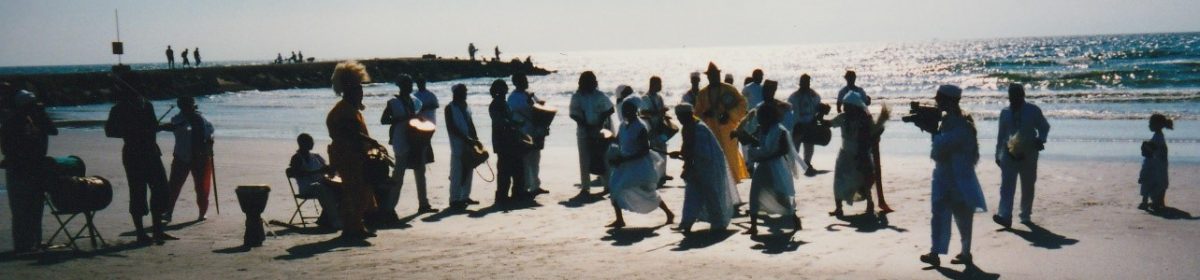
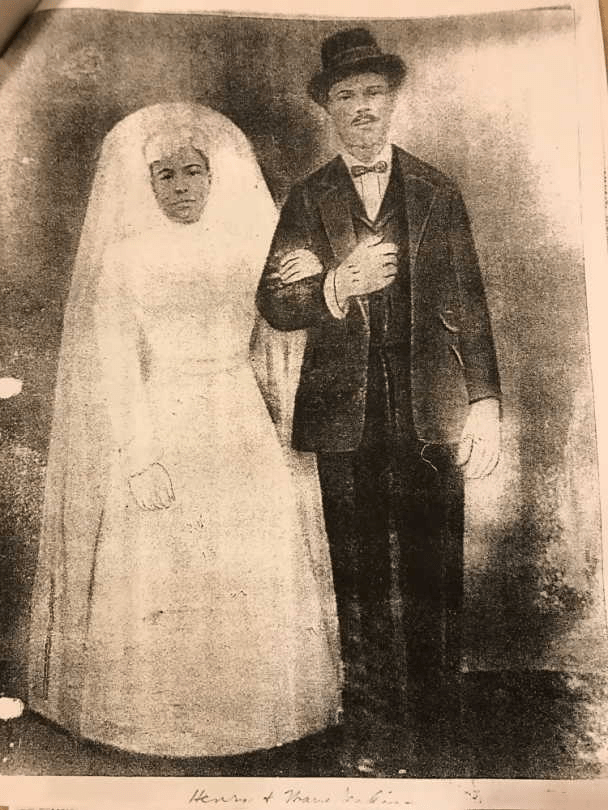
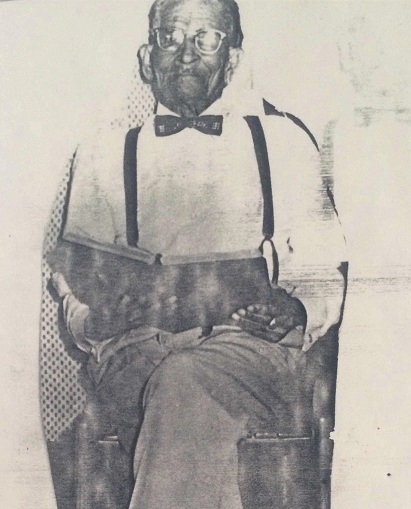
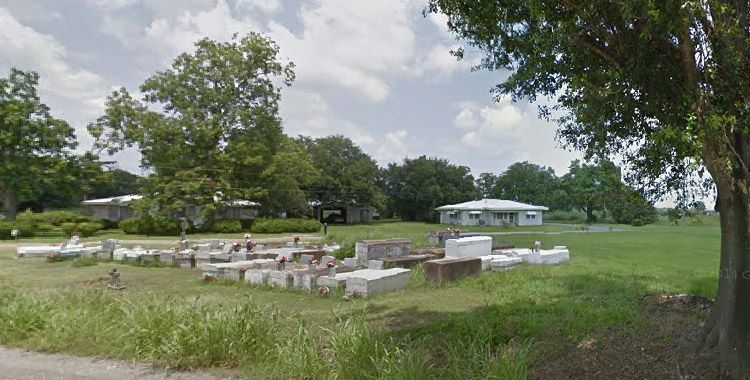
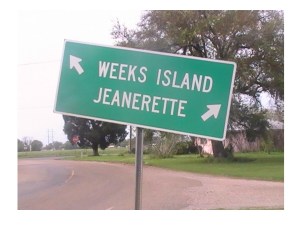
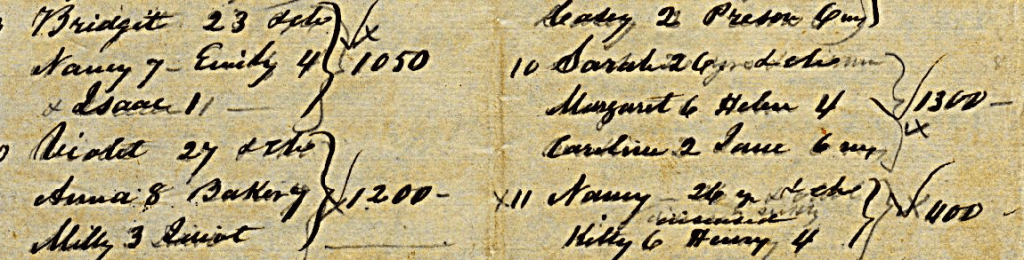
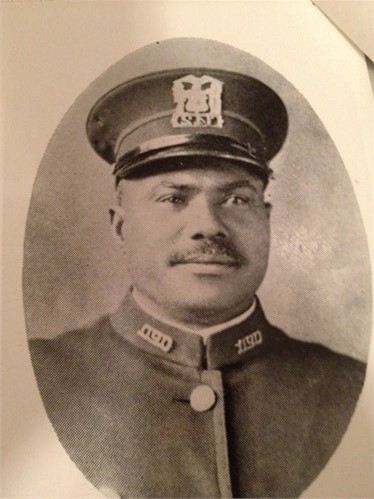
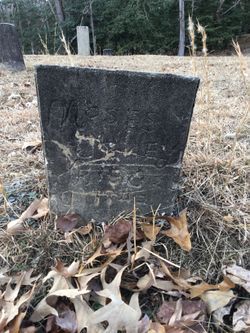
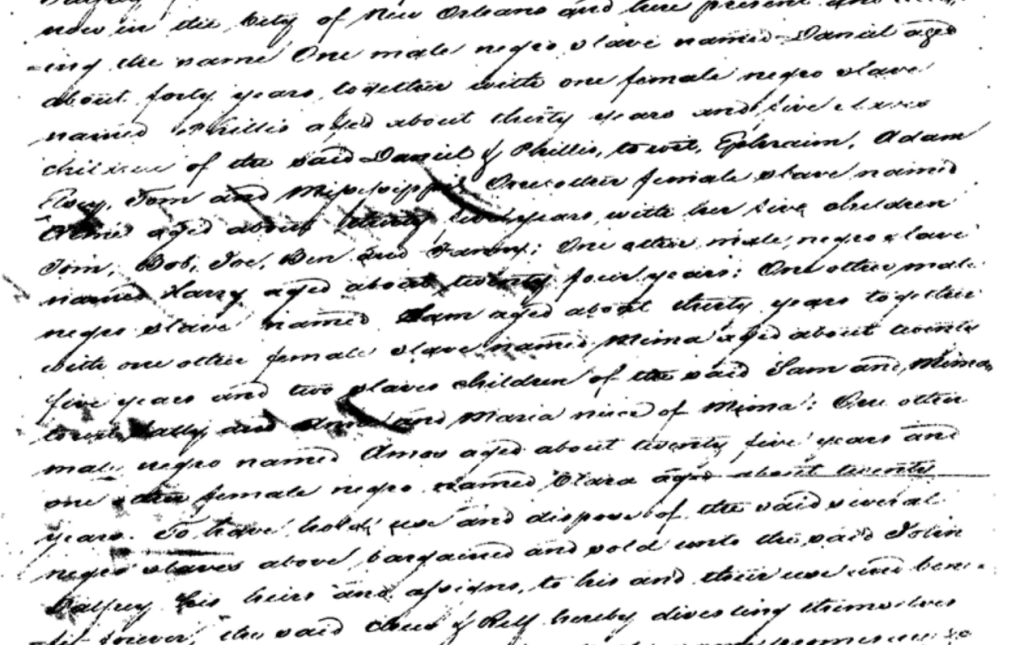
 My Maryland-Louisiana Roots