Have We Met Before? Unknown Kinship Crossings!

I began genealogy research in 2000 starting with my husband’s ancestral roots in Matagorda and Wharton County, Texas.  I quickly found that the Rivers branch of his family tree included a man born about 1840 by the name of Juan Rios.  Juan and freed slave Eliza Moore had several children, who were born in either Brownsville, Cameron County, Texas or Matamoras, Mexico and were recorded on the 1860 U.S. Census living in Brownsville.  Charlie Rivers and his siblings, Emily, Archie, Ben, Victor, John and Angela were listed on the 1870 Cameron County, U.S. Census with their mother Eliza Moore.  Juan was not included in their household and or any 1870 U.S. Census record.

I wondered what had become of Juan.  Charles Rivers was reported to have always told stories about his father being a Spanish soldier.  So, I kept looking for Juan.  I found him listed on the 1880 Cameron County, Texas census.  He was listed as a ‘laborer’ on both the 1860 and 1880 U.S. Censuses.  I have not yet found Juan on any census listing for 1900 but he was counted again on the 1910 Census in Brownsville.  He was listed as a 76-year-old laborer and widower who worked odd jobs.  I obtained Juan Rios’ death certificate.  His son, Leonides Rios, was the informant for the death certificate information.  He provided the names of Juan’s parents as Pedro Rios and Angela Lasas.  He also reported Juan’s occupation as “retired soldier”.  Juan’s military service appears to have been a highlight in his life.  So much so that both sons, Leonides and Charlie, recounted his service when asked about him.

I obtained Juan’s Civil War pension application and discovered that there was a big controversy in substantiating Juan’s military service.  Two men, both named Juan Rios, filed pension applications.  Both men claimed to have enlisted while living in Brownsville, Cameron County, Texas.  One of the men reported that he had been shipped to Franklin, St. Mary Parish, Louisiana where he fought in a couple of skirmishes.  This was quite interesting because my ancestral roots are in St. Mary Parish, Louisiana.  I joked with my then husband that maybe our ancestors had crossed paths way back then!!  This Juan was later determined to have perhaps been an imposter whose actual name was Nabor Rios.  Nabor’s family contested his story and said that he had never served in the military.  The other man was deemed the true Juan Rios.  His testimony was that he’d served as a scout for the Union troops in the Brownsville area and that he had never left Texas while in the Army.  So, it seemed that my husband’s and my Louisiana family’s paths had not crossed.

I continued researching my husband’s family tree for the next fifteen years.  In 2015 I began to focus on my own Louisiana familial roots.  I joked that my husband’s Texas family and my Louisiana family might turn out to be related in some way or another through some distant shared kin.  I still had the story about Nabor Rios on my mind.

I’ve recounted in my blog, how I stumbled on my Morgan-Gibson-Riggs roots on John Palfrey’s 1843 St Martin Parish, Louisiana probate and my Guy-Jenkins roots on David Weeks’ 1835 and 1846 St Mary Parish succession records.  Research revealed that my Sam and Mima Riggs branches included grandchildren: Moses, William, Charles, Caroline and Sarah Woodlin.  Sam, his son Sam and daughter Anna and her children were freed upon Palfrey’s death by his John Gorham Palfrey.  Sam Riggs, Sr. elected to remain in Louisiana, but his newly freed grandchildren were shipped to Boston.  I found them on the 1850 U.S. Census, living in Ontario County, New York.  Additional research revealed that William P. and his brother Moses Woodlin both served in the Union Army during the Civil War.  I received William P. Woodlin’s pension application and learned that although he enlisted in Pennsylvania’s 8th Regiment, Co. G, his actual service was in Brownsville, Texas.  He recounted in his pension application that he and fellow soldiers marched from Brazos-de-Santiago to Brownsville, Texas.  So, I’d found a Louisiana ancestor, who by way of New York and Pennsylvania had found his way to Texas and may have crossed paths with Juan, Eliza or their children.

My niece Latrice and I visited Calvert County, Maryland in August 2023.  While there we did the usual genealogy research stuff—looked up deed and marriage records and visited cemeteries and churches.  We also received several research leads from Maryland natives: Beverly Foote and her sister Yvonne, David Buck and Michael Kent.  One of those leads helped uncover William “Peter” Kent’s Civil War story.  I am not directly related to Peter, but he was the grand-father-in-law of my 3rd great aunt Charity Gross.  Charity was my 4th great grandmother Charlotte Phillips’ daughter who she was forced to leave behind in Calvert County, MD.  Seventeen-year-old Charlotte was shipped to New Orleans, Louisiana in 1851 aboard the Baroque Virginian.

I requested and received Peter’s Civil War pension file.  The 100-page document was a very interesting and ‘entertaining’ read.  Peter served in the US Colored Troops, 7th Regiment that was present in several battles: Chaffin Farm, New Market Heights, the fall of Petersburg, Va and the surrender of Lee at Appomattox Courthouse. The 7th was later shipped to Indianola, Texas.  Indianola is in Calhoun County, a neighboring county to Matagorda County which is where my former husband’s family lived.  Peter eventually travelled to Matagorda County where he met and later married Rhoda Woodkins.  Albert Gantt testified for Peter’s pension application that he’d known Peter since boyhood and that his cousin Basil Kell had served in the 7th Regiment with Peter and had witnessed Peter’s marriage to Rhoda in October 1865.  Gantt recounted Basil Kell’s story of how both he Basil, and Peter both dated Rhoda and how Basil fell in love with her only to learn that she preferred Peter.  Basil reportedly held a gun on Peter to ensure that he carried through with his marriage to Rhoda.  Yes, a truly entertaining story!  

In any case, Peter and Rhoda were married in St John’s Methodist Church in Matagorda County.  The church is located in the town of Matagorda on a little peninsula in Palacios Bay.  When I read that I thought, ‘hey I visited that church back in 2003’!  My husband’ s 2nd great uncle Anthony Moore’s mother Hester had attended that church and sat in the ‘Colored’ section while a slave.  His 3rd great grandmother Missouri Hayes had lived within blocks of that church until 1889 or so.  I don’t know if she or any of her children attended the church back in the 1860s, but they were definitely in the vicinity.  I also don’t know if Peter was ever on the mainland of Matagorda, but he was in the vicinity

Peter Kent and Missouri or her children: Isham, Sherman, Emily or Minnie Hayes may have crossed paths with Peter.  Did they know one another, did they speak to each other or simply nod as they passed one another on the streets of Matagorda? Who knows?

I don’t know why I continue to be surprised as I find instances where family members paths have crossed throughout time.  I would love to know if conversations or friendships, however brief, accompanied those path crossing encounters!  I most likely will never know, but hopefully I’ll makeup a story and write it all out one day! Who knows?

Best,

P.S.

I obtained 75 more pages of Peter Kent’s military pension file and learned more information on his life before and after slavery.  And out of the blue, just because, I got a message from an almost DNA cousin, Shelby Evans.  I say almost cousins because she and my mother don’t share any DNA, but they match people who match each other.  Shelby had obtained the pension file for her Calvert County ancestor who served in the Civil War and found Peter Kent’s name mentioned.  I reviewed Peter’s pension file and noticed that her ancestor was a reference for Peter.  So, she and I swapped pension files and didn’t have to pay the fee and then wait for 4 months.  And while I thought the original story about Peter and Rhoda was crazy, the details in what Shelby provided were ‘chock-full-of-wows’.  Who knew reading pension files could be so interesting??

Genealogy research uncovers so much unknown history.  I learned that many Maryland slaves escaped and/or were taken aboard British ships during the War of 1812.  Some were shipped to Caribbean Islands, some to Canada and others to Liberia.  Who knew?

I learned that approximately 60 other Maryland enslaved men were freed and shipped to Texas during the Civil War.  Peter Kent, Thomas Torney, Samuel Key and John Ross were all freed by Basil S. Dixon to serve in the Civil War.  Dixon received a bounty of $300 for each man that enlisted.  Each man received a ‘premium’ of $2. See Michael Kent’s book, Mulatto: The Black History of Calvert County.
Creating Lazarus Kits in Gedmatch

I created an account in Gedmatch.com early in my DNA genealogy research. In 2015 a 4th cousin match to my mother’s Ancestry DNA messaged me and asked that I create an account in Gedmatch. He did not detail the advantages of using Gedmatch but he periodically continued to ask. I could see that he and my mother shared 25cM of DNA. I didn’t know what a cM was or if a 25cM match was worth investigating. I finally did create an account and discovered that their match was on chromosome 11. I compared his DNA with my mother’s and saw the people who matched 1 or both kits. I was able to see his family tree, which was also in Ancestry.com. A unique tool in Gedmatch allowed me to see that some of the people that he and/or my mom matched, were not always matches to he and my mom. I then looked at some of these non-matches for my mother and found that some did match some of my mother’s other DNA cousins. Interesting right! That is the randomness of DNA inheritance.

In 2015 Ancestry had something called DNA circles to which everyone’s DNA was assigned. I never really got how the circle thing worked and pretty soon the circles were replaced with Parent 1, Parent 2 and Both Parents subgroups. I found this tool helpful. I’d figured out how a key DNA profile was connected to my mother’s DNA. She was in the Parent 1 subgroup and her 2nd great grandmother and my mother’s 3rd great grandmother were sisters. That person’s DNA was also in Gedmatch and my mother matched her on 8 chromosomes, 10 segments including 2 segments on the 23rd. So, the whole group thing worked for me. That is until I looked recently and saw that this person’s profile in Ancestry is now in the Unassigned group. What happened!!

Throughout my research using DNA tools, I have found that what begins as a trek through shared matches with profiles along my Parent 1 branches often mysteriously goes off track and lead to matches on my Parent 2 branches. So, how did this profile that I thought was concretely attached on my mother maternal Phillips line become Unassigned. Why was this key profile not placed in the ‘Both Parents’ subgroup?

I decided to try out the Gedmatch Lazarus Kit tool to try and replicate my mother’s parents DNA profiles. I used my mother, siblings and close family on my mom’s maternal and paternal side that were in Gedmatch. To create a robust Lazarus kit for each of her parents, I had to do 2-person kit comparisons to find enough DNA profile matches to meet the 1500cM threshold required by Gedmatch. When I compared my key Phillips’ matches DNA to my mother’s DNA in an attempt to fill out her mother’s Lazarus kit and other cousins’ DNA to fill out her father’s Lazarus kit, I saw significant people show up as matches for her maternal and paternal Lazarus kits. It finally sunk in. My key Phillips match was indeed a match somewhere back in time to both my mother’s father and her mother.

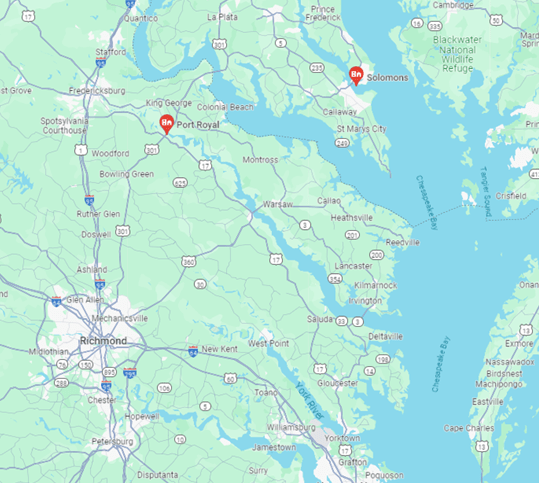
I’ve traced my mother’s Parent 1, maternal line branch back to Calvert County, Maryland through Charlotte Phillips. Charlotte’s husband was Joseph ‘Young’ Smith who was born in Kentucky. This 1 part of her Parent 1 bucket. Her oldest known ancestors along her Parent 2 branches were supposedly all born in Virginia and North Carolina. One of her ancestors on the Parent 2 line has a number of matches whose ancestors lived in Caroline County, Virginia. When I looked at a map, I found the distance between Calvert County, Maryland and Caroline County, Virginia to be about 55 miles.

55 miles!!

Map, Port Royal, Virginia to Solomons Island, Maryland

What do you do, when what you thought you had nailed down in your research, turns out to be just another pivot down another rabbit hole?

Well, I am attempting to get more close cousins on both sides of my mother’s tree to upload their DNA to Gedmatch in hopes that I can nail something else down. Hopefully, these Lazarus kits will help sort things out!

Best,

Eagerly Awaiting Once More

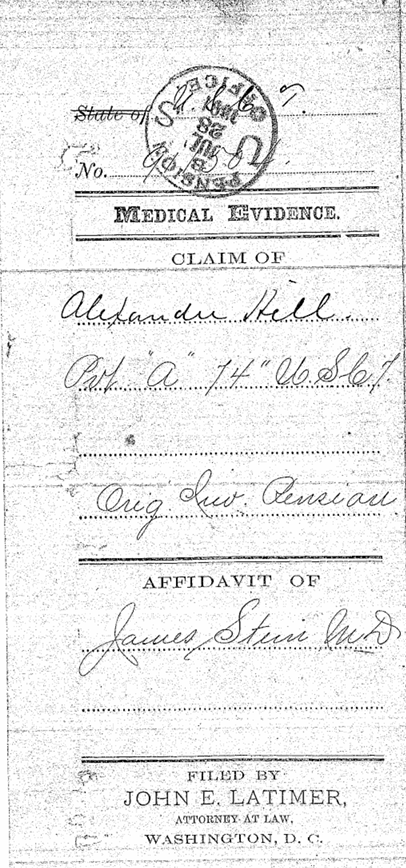
I posted a few days ago that I was eagerly awaiting records from NARA regarding Alexander Hill’s Civil War pension. As fate would have it, I awoke the very next morning to find an e-mail message with a link to a digital document containing the remaining twenty-eight pages of his pension record! I read through the pages hoping to see if the plantation where Alexander was enslaved was mentioned and if any mention was made of his siblings.

Two witnesses provided differing information on where Alexander was enslaved. Alexander’s wife Rose testified that he had been born in Virginia and was a slave of Chodelle Rousselle who lived somewhere “…up the Mississippi River.” Rousselle died and Alexander was sold to someone named ‘Whale‘ who “brought him to the southern part of Louisiana.” Alexander told her that he’d been in New Orleans 4 years before the war. She said that Alexander had brothers and sisters in Virginia whom he unsuccessfully attempted to locate.

Jacques Darensbourg testified that he’d known Alexander for fifteen years before the start of the Civil War. Both he and Alexander had served in the 74th regiment. He could not say with any certainty if Alexander was born in Virginia. He stated that Alexander had been a slave of Felix Garcia who lived about 8 miles from Boutte in St Charles Parish. Darensbourg further testified that Alexander had not been married while a slave and that he knew of Alexander’s marriage to Rose in 1866. He said that Alexander had not lived in New Orleans before the war, but that they both enlisted in New Orleans.

So, I received the information that I had been eagerly awaiting. I found the names of 3 possible people on whose plantation Alexander may have lived. Alexander was reported to have brother and sisters who lived in Virginia. Neither Rose or Darensbourg mentioned that Alexander had a brother living in St Charles Parish.

So, it seems that my great-great grandfather Robert Hill was most likely not Alexander’s brother. Both men were born in Virginia and both lived in Boutte Station, St. Charles Parish, LA in 1870. Both reported Civil War service on the 1890 Veterans Schedule. Alexander kept his discharge papers and filed for and received a military pension. When he died in 1905, his wife Rose applied to keep his pension. Her application provided a great deal of information about her family and their movements and some information on Alexander. Robert Hill lost his discharge papers and was unable to receive a pension. I last found Robert on the 1900 US Census in the household with his daughter Celestine Crowder. I have not yet found Celestine and family on the 1910 census. I did find Celestine Crowder and family in St Mary Parish on the 1920 census working on the Alice B plantation. I found a 1939 death record for a 101-year-old Robert Hill. But have never found any record of Robert Hill living after the 1900 census. I assume that the 1939 death certificate is actually for Robert Hill Jr.

Although it seems that Alexander and Robert may not have been brothers, both were living in Boutte Station in 1870 and both had the last name of Hill. Perhaps the name ‘Hill’ is what connects the 2 men. I am now searching probate records and New Orleans ship manifests for Alexander and Robert listed together. I recently found an index listing for New Orleans notaries at https://www.orleanscivilclerk.com/notaryalpha.htm. I also found a possible manifest of an Alexander and a Robert coming to New Orleans on the same ship. I am attempting to request the detail pages regarding the manifest.

And so I am once again eagerly awaiting!

Best,

Eagerly awaiting…

I found information in 2021 that documented my enslaved ancestors with the last names Gibson, Morgan, Guy and Jenkins. All of these people were enslaved on the plantations of 2 related families: the Weeks and Palfreys. Since then, I have been searching for similar documents regarding my St. Charles Parish ancestors Robert Hill and his wife Charlotte Alexander. Robert was born about 1821 in Virginia. He was counted in the 1890 veteran’s census. According to the census, he had lost his military discharge papers and so was not able to provide information on which company or regiment he served. A few pages before Robert’s name was a listing for Alexander Hill. Alexander Hill had retained his discharge papers and in fact lived long enough to apply for and receive a pension for his Civil War service. 

Alexander served in the US Colored Infantry, Company A, Regiment 74 from September 6, 1862 to October 11, 1865. I applied for Alexander’s Civil War pension application with hopes of finding out if Alexander and Robert Hill were related. Often included in pension records is information about the siblings, or wife and/or children of the applicant. In other pension records, I have found the name of the plantation where the applicant lived. 

I requested Alexander’s file electronically July 3, for a base price without knowing how many pages it would contain. I then received an e-mail message on December 26 alerting me that the requested pages were available for download. I received 100 pages of Alexander’s pension file. Included were the names of his children and his wife, his medical records, information regarding his marriage to Rose Matthews in 1866 and deed information about land purchased in 1879. Alexander had applied for and received a pension of $20/month. He had died March 1905. Unfortunately, most of the information that I received centered around Alexander’s widow Rose, who survived him and applied to continue receiving his pension and for help with his burial. There wasn’t any information regarding his life as a slave or any mention of siblings, parents or his place of birth. 

Two weeks after I downloaded the file from NARA, I received a letter from the national archives letting me know that there were an additional 28 pages from Alexander’s pension file that I could request. I don’t know why I wasn’t informed that an additional page were available in December when I was emailed the download link. Evidently, NARA sends you up to 100 pages per request for a price. If additional pages exist in the file, they then write to you and let you know of the availability to request those additional pages. And so, I requested the additional pages. Of course I did!!

And so, I am back in the queue, waiting for someone at NARA to repull Alexander’s file, copy the pages and send me another download link. In other words, I am eagerly awaiting …

Best,

William Green

William Green was the husband of my great-great-grand-aunt Charity Gibson. Charity was the daughter of my third great-grandfather Robert ‘Bob’ Gibson. Robert ‘Bob’ and his mother Amie were purchased by John Palfrey from Relf and Chew in New Orleans on March 13, 1811. William’s married daughter Ellen Betts was interviewed by the WPA as a part of the Texas Slave Narratives.

William was born about 1810 in South Carolina. His oldest child for whom I have documentation was Sidney Green, who was born in 1842. William and Charity Green had eleven children: Sidney, Sarah, Ellen, Washington, Alice, Permilla, Mary, Cornelius, Nettie, Elliott and Henry.

Information about William was written in William Taylor Palfrey’s plantation journal. Palfrey wrote about William ‘Bill’ Green running away on Dec. 1, 1849 and returning on his own accord. Bill was referenced by his full name, Bill Green. Why Bill ran was not recorded in the journal, but when I read about this, I thought that it perhaps provided a clue to Bill’s personality. I recently found a Freedmen’s Bureau complaint that provided more information on William. Wm Hughes filed a complaint that Bill was in violation of his contract to work at the Burris Plantation, Bayou Boeuf Station.

Hughes wrote, “I have a Freedman here that will not do what I tell him, he says he will work when he pleases and quit when he pleases. I want you if you please to take him off this place or let me know if I can have him removed by a civil officer. He goes off when he pleases attending to other people’s business instead of helping the other hands to get the grass out of the cotton.”

Freedmen’s Bureau, Franklin, Court Roll #77, page 23B, image #96, August 4, 1866

William’s name appeared again in Freedmen’s Bureau records. William, Daniel Fisher and Isaac Sutton as heads of households filed a request for assistance on May 16, 1867. Their application read:

…4 men, 3 women, 3 children of Brashear City; County of St Mary, and State of Louisiana do solemnly declare, and upon our word of honor, certity, I (or we) are in absolute in need of food, “to prevent starvation and extreme want,” rendered so by the circumstances: having been driven from our homes, by the high water and lost all of crops.

Freedmen’s Bureau, Record of Field Offices, Roll M1905, 078

The application was received by Sgt. J.W. Keller. Fifty pounds of pork and 289 pounds of corn meal was approved for distribution by the Joint Resolution of Congress, approved March 30, 1867. The ration was issued to cover a 20-day period. A note at the bottom of the page indicated that a legal bushel of corn was fifty-six pounds.

After returning from his service in the Louisiana State Senate, William T Palfrey wrote in his plantation journal on April 27, 1867,

“the water from the Mississippi has reached an alarming height. It is now about 4 inches only below the mark of 1865 and 14 inches below the 1828.” He wrote that the water rose 1 3/4 inches the next day, followed by 2 inches on the next 2 successive days and 4 inches on the fourth day. Palfrey continued to note the rising waters and wrote about a neighbor leaving the land “as fast as they can.” He then prayed that, “God give them a safe deliverance.” He continued writing, “I look upon this flood of water as nothing compared to the political flood of fanaticism & anarchy, now sweeping out & desolating the land.”

The New York Times ran a story on April 4, 1867 about the March 28, New Orleans floods, the failing levees and the loss of people and land. The Times also compared the decaying levee system to the changing times and the change in relations between land-owners and previous enslaved workers of the land.

Best,

William P Woodlin

I recently obtained William P Woodlin’s Civil War pension application with the hope of learning more about the family that he left behind in St Martin and St Mary Parish, Louisiana. William’s mother’s name was Anna. Anna was born about 1807, most likely in North Carolina. She and parents, Sam and Mima Riggs, along with her sister Sally were sold as slaves by Beverly Chew and Richard Relf to John Palfrey in New Orleans on March 13, 1811. William and siblings: Sarah, Moses, Charles and Caroline along with Anna were freed in 1843 by John Gorham Palfrey upon the death of his father John Palfrey. William and nineteen other slaves were freed at that time. His grandfather Sam Riggs chose to remain in Louisiana as did at least 3 other elderly freed persons. William, Sarah, Moses, Charles and Caroline all lived in or near Ontario and Monroe Counties in northern New York state 1850-1860s.

William joined the Union troops, August 20, 163 in Syracuse, NY. He served in Company G, Regiment 8 of the USC Infantry for a term through August 31, 1865. His commanding officer was Captain James S. Thompson. William’s pension file revealed that he mustered out of the Army as a corporal on November 1, 1865 in Brownsville, Texas.

He applied for a military pension with the Adjutant General’s Office on July 23, 1888, under an invalid disability when he lived in Calhoun County, Michigan. His disability application, N0.666.293, detailed how he and his company were deployed to the Rio Grande river on July 12, 1865. While “marching on dusty roads and through clouds of dust” to Brownsville, William and many others suffered from sunstroke because of the extreme heat. This sunstroke event left him with dizziness, nervousness and brain trouble. He was reportedly not treated in any hospital at the time. His application indicated that he never fully “recovered from the effects of the disease then incurred…” William was described as a forty-six-year-old, partially disabled man, 5′ 10″ with black hair and eyes and a black complexion. His occupation was listed as farmer and book agent.

Two friends: William D. Rogers and Pery Sanford filed affidavits that they’d known William P. Woodlin for fifteen and eighteen years, respectively. They attested that he was only able to do ‘light work’ on ‘easy jobs.’ He also was reported to have been often confined to bed for periods of time. Dr. George McNiell was reported to have treated William with ‘patent medicines’ for his ‘home treatment’ for a number of years. William was later examined by Dr. SS French of Battle Creek and a member of the Board of Medical Examiners.

William wrote in his own 1888 affidavit that he’d moved to Barry County, Michigan after discharge from the Army in 1865 and lived there until 1871. He then moved to Omaha County, Kansas where he lived for 2 years before moving to Battle Creek Michigan, spring of 1874…where I have since made my home, 41 East Hall Street, Battle Creek, Mich, being my Post Office address. My occupation during all that time has been that of a Farmer, Laborer, Teacher & Book Agent.

William also wrote that his, “first attack of the disease was on the march from Brazos De Santiago to Brownsville, Texas, July 12th 1865. The intense heat, dusty roads and muddy water caused a great many to fall out by the way & some to die as reported at the time…In the harvest of 1867, I was again prostrated with the sun, lost about 2 days of the harvest of 1877. I think I had more severe attacks, laid off some days, and for nearly two years last past I have done no manual labor. And during all the years have passed since my discharge to present time, I have not been one fourth the man physically that I was before I was sunstroke as above related. Dr. Simeon S French has been my principal doctor & Dr. George McNeill both of whom reside in this city. All of which is respectfully submitted by Wm. P. Woodlin”

“…and have 5 children now living… my oldest boy is a Michigan School graduate of last year. I must close with kind regards. I am respectfully yours, Wm. P. Woodlin:

letter written by Wm. O. Woodlin to Mr. J. C. Black, Commissioner of Pensions

Per William’s Oct. 1889 physical examination, his vital stats were: pulse rate: 70; respiration: 19; height; 5′ 10″; weight: 159lbs, age: 49; temperature: 98.4. Other conditions reported: “muscles of whole upper extremities jerking and twitching all the time during this examination, no patella reflex, very difficult to walk with eyes closed…”

William wrote to the Examining Board on October 30, 1889 to say that he’d located 2 other men who could confirm his service and illness. He named William H Randalls of Columbia Co. Pennsylvania who was in the ‘band’. He located another man, Elijah Reynolds of Pittsburgh, who was in the ‘Band & belonged to the S Eng Company and played the Bass horn…” He wrote that he was unable to get either to reply to his letters and that he was “unable to go to see these parties by reason of my poverty. I have found them since your letter of last month.

J.B. Jones of Pottsville, PA wrote to the Examining Board on August 16, 1889 on William’s behalf. Jones’ testified that,

‘on or about the 12th of July 1865 Wm P Woodlin while on duty as member of the Band of the 8th Regt USCI of which I was leader at the time; was by sunstroke effected that he fell; and was relieved from duty at the time, and it so effected his head he always after complained of pain in head; and his sight seemed to fail him while in service, was discharged on about Dec. 9th at Philadelphia, PA, the above happened at Ringgold Barracks, Texas. I have not seen nor heard from him since, until he wrote me concerning his claim…”

William was awarded a pension at the rate of $24/month to commence on May 27, 1891. His disabilty was identified as ‘disease of nervous system, result of sunstroke’. His next communication the Dept of the Interior was June 4, 1898 when he was living in Bowling Green, Kentucky. He supplied answers to a questionnaire to obtain his next quarterly pension payment. He answered that he had been a widower for 9 years and had been married in Syracuse, NY by Samuel J May. He attested to being married only once and that his living children were: Alice M, born Feb, 12, 1867, Wm. J, born Nov. 3, 1868 and John P, born Dec. 21, 1870.

At the time of the 1900 census, William was 58 years old, widowed and living in Bowling Green, Warren County, Kentucky where his occupation was recorded as a missionary. He could read and write. He was enumerated in the home of a Black physician, Dr. Leonides Webb. William died July 22, 1901, while living in Kentucky. His son William Jeremiah Woodlin, MD and Alice May Woodlin lived at 417 Winchester Ave. in Ashland, Boyd County, Kentucky.

Unfortunately, William’s pension application did not mention his parents, his siblings or his life in Louisiana. I still am happy that I sent off for the records and content with the information uncovered. While in Brownsville, Texas, he was closer than ever to his St Mary Parish, Louisiana roots. I wonder if he was able to get word to his living Louisiana relatives. I wonder how he traveled to and from Texas while in the Infantry. I wonder how and why he was stationed in Texas. So many questions are swirling in my mind, I just need to determine my next research move!

Read more on my Woodlin family

Best,

Another Great Research Find!!

I continue to be amazed by the tools available for African American genealogy researchers to find information on their ancestors prior to 1870. I had visited the Maryland State Archive site many times to obtain death records. But it wasn’t until recently that I found this Legacy of Slavery in Maryland database. Included in the database are records of manumitted slaves, freedmen who served in the Civil War, slaves listed in inventories on probates, ads for sales of slaves as well as accommodations made for run-away slaves via the ‘Underground Railway’. Users can search by county, by the names of the slave or the enslaver.

So happy to have once again stumbled upon another great find!

Best,

‘Lost Friends’ – An Amazing New Find

I began my genealogy research in 2000 at a time when very little content was available digitally or online. Microfilm and microfiche readers were the staple tool for viewing birth, death, immigration, probate and deed records. As genealogy research has become more widespread, so has the access to and transcription of important records. Freedmen Bureau letters, complaints and work contracts once available only as images that you had to scroll through to find names and places of interest are now widely accessible on Ancestry.com and FamilySearch.org via keyword searches.

People and organizations have been very busy providing information to help unlock the ancestral roots of once enslaved Black peoples. I recently attended a panel discussion at Prairie View A&M University’s Ruth J Simmons, Center for Race and Justice. Rice University Professor Domingues gave a presentation on the SlaveVoyages.org database. A database that has been around for quite a while that was available initially via CD-ROM access only but is now a robust digital tool. SlaveVoyages ‘explores the origins and forced relocations of enslaved Africans across the Atlantic world.’

Today, I stumbled upon a true treasure-chest–the ‘Lost Friends’ database. Included in this database are over 2,500 letters or ads in which Black families separated by slavery or separated after emancipation attempted to locate family members. The ads ran in the New Orleans Southwestern Christian Advocate newspaper November 1879 – December 1900.  Content was provided by Hill Memorial Library, Louisiana State University Libraries (1879–1896) and the Bridwell Library, Southern Methodist University.

I have already found ads for families that lived in Jeanerette and Franklin, Louisiana as well as those in Double Bayou, Matagorda and Bremond, Texas.

It is hard to keep my focus when such great research tools keep popping up. You can search by lastname, year or location. I have found that wide searches on parish names or county names is not as successful as searching specifically by city names. So a search for Jeanerette may produce records while a search on Iberia Parish, may not.

So, check out ‘Lost Friends’ and see what you can uncover.

Best,

Digging Deeper in Monroe County, Alabama

My mother’s initial 2015 DNA matches in Ancestry.com included high matches among people whose ancestors lived in Monroe County, Alabama immediately following the end of slavery. She also had 4 or more matching profiles whose enslaved ancestors lived in Drew County, Arkansas. These profiles also matched those Monroe County, Alabama profiles. These Alabama and Arkansas profiles in turn matched her Calvert County, Maryland and Iberia Parish profiles. This led me to prematurely jump to the conclusion that the Maryland women at the top of the family trees of both the Alabama and Arkansas profiels were the connection among all of these people. Those women were Flora Matilda Tucker Stallworth born about 1846 in Maryland, who lived in Monroe County, Alabama and Rosetta Fleming Goodwin born about 1830 in Maryland who lived in Drew County, Arkansas.

I have since discovered that while Flora Matilda Tucker may indeed be a connection to our Calvert County ancestors, she is but part of the explanation for the connection. In 2022 and 2023, I found an additional 6 profiles with Monroe County, Alabama ancestors and 8 more profiles with Drew County, Arkansas ancestors that match my Calvert County, Maryland direct lineage. Among these new Monroe County profiles, 3 or more profiles have no currently known descendancy from Flora Matilda. These 3 profiles have Jeff Malden and his wife Ella Salter as direct ancestors. Jeff Malden’s mother was Mary Tucker who was born about 1825 in Alabama. These DNA profiles: Longmire, Carpenter and Gant, also match the Drew County, Arkansas and Calvert County, Maryland DNA profiles as well as my mother’s.

Flora Matilda’s maiden name was noted to have been ‘Tucker’ by several people who include her on their family tree. I have not been able to find any definitive document to validate this as her maiden name. I have been told that she was shipped out of Maryland and initially lived in New Orleans before she was sold and brought to Alabama. Her descendants recount how Anderson Stallworth met Flora Matilda, who had lived on a different plantation, once they both were freed. The exact name of the plantation on which she lived does not seem to have been passed down in the telling of her story.

So, I am taking a deeper dive into Monroe County, Alabama to unravel what seems to be a more complicated DNA connection. A connection that may include a Maryland component as well as a South Carolina and maybe Kentucky component. Salter, Longmire, Malden and Tucker are names on which I will be focusing.

Best,

Haplogroups, What Are They?

According to TwentyThreeAndMe, haplogroups allow you to trace your maternal or paternal ancestors back in time “to a mutation in a particular place and time” and to follow the migration of people to different regions and track the mutations to their DNA. Haplogroups are a combination of letters and numbers. Haplogroups do not necessarily provide you with the genetic mutation of your most distant maternal or paternal ancestors. Every person inherits mitochondrial DNA, but Y DNA is only inherited by men from their fathers. Accordingly, the mitochondrial haplogroup that men belong is only inherited from their mother, who inherited it from her mother and so on.

The mitochondrial DNA of North American natives was one of the first DNA groups to be studied intensively. And as such, the first maternal haplogroups begin with the letters A, B, C and D to include North American natives and their more distant ancestors. African mitochondrial DNA was studied much later and by that time haplogroups naming nomenclature was at the letter L. Most Africans and African Americans belong to the maternal haplogroup L. My mother’s haplogroup is L2a1f. H is largest maternal haplogroup for people with European ancestry.

Y haplogroups were created after mitochondrial DNA was studied and began in African where human life began. Y haplogroups therefore begin with the letter A and reference people with African Ancestry. E-P252 is the haplogroup of most of my cousins with predominantly African ancestry. Somewhere along the line, European male ancestry was introduced into my family tree. The haplogroup of most of those current male DNA cousins begins with R and more specifically R-CTS??

How important are haplogroups? I am still looking for answers to that.

Read more about haplogroups

TwentythreeAndMe haplogroups

Best,

Design a site like this with WordPress.com
Get started